
The Rocking-Horse Winner by D. H. Lawrence: Full Illustrated Story and Fantasy Analysis
In childhood, the distinction between what is real and what is imagined is not always clear. A familiar object may acquire an unusual significance, and an ordinary event may seem to suggest something beyond our understanding. Stories sometimes draw upon this uncertainty, allowing the impossible to enter an otherwise familiar world without explaining precisely how or why it occurs.
D. H. Lawrence’s The Rocking-Horse Winner begins in a comfortable English household. The family appears to have everything necessary for a happy life, yet its members remain troubled by a persistent sense that something is missing. The children become aware of this dissatisfaction without fully understanding its cause. Gradually, their home begins to seem less ordinary than it first appeared.
The strange events that follow are presented alongside familiar concerns about money, affection, and family expectations. Lawrence does not immediately explain their significance. Instead, he allows the reader to encounter them much as the characters do, with limited knowledge of what is happening and why.
As you read, notice how Lawrence introduces unusual events into an otherwise recognizable world. Consider which occurrences seem to belong to ordinary experience and which appear to exceed its limits. Pay particular attention to the relationship between the family's desires and the increasingly mysterious events within the household.
When we return to the story, we will examine how Lawrence uses fantasy and the supernatural to explore experiences that ordinary descriptions of family life might leave concealed.
D. H. Lawrence (1885–1930)

❦ Five Things to Know
✠ Born David Herbert Lawrence in Eastwood, Nottinghamshire, England, in 1885. His father was a coal miner, while his mother, a former pupil-teacher, later worked in the lace industry.
✠ Trained as a schoolteacher at Nottingham University College and taught at Davidson Road School in Croydon from 1908 until illness brought his teaching career to an end in 1912.
✠ Published several influential novels, including Sons and Lovers (1913), The Rainbow (1915), and Women in Love (1920), examining family relationships, sexuality, social class, and the conflicts between individual desires and social expectations.
✠ Challenged the moral conventions of his time, particularly in his treatment of sexuality. The Rainbow faced prosecution and suppression in 1915, while Lady Chatterley's Lover (1928) became the subject of major censorship controversies.
✠ Became a significant figure in twentieth-century English literature. His fiction, poetry, and essays explore human relationships, emotional conflict, and the tensions between instinct, modern society, and industrial civilization.
❦ His Writing Style
D. H. Lawrence was particularly interested in the emotions and desires that influence human behaviour, often without the characters themselves fully understanding them. His fiction examines the tensions between instinct and social convention, personal freedom and family expectations, and emotional needs and material circumstances. Rather than explaining these conflicts directly, Lawrence frequently develops them through relationships, recurring images, and symbolism. In The Rocking-Horse Winner, he introduces elements of fantasy and the supernatural into an ordinary household, allowing the family's unspoken anxieties to acquire a disturbing presence.
⁂ More Works by D. H. Lawrence
Sons and Lovers (1913)
The Rainbow (1915)
Women in Love (1920)
❝ Memorable Quote
“Never trust the artist. Trust the tale.”
— Studies in Classic American Literature (1923)
The Rocking-Horse Winner
By D. H. Lawrence
There was a woman who was beautiful, who started with all the advantages, yet she had no luck. She married for love, and the love turned to dust. She had bonny children, yet she felt they had been thrust upon her, and she could not love them. They looked at her coldly, as if they were finding fault with her. And hurriedly she felt she must cover up some fault in herself. Yet what it was that she must cover up she never knew. Nevertheless, when her children were present, she always felt the centre of her heart go hard. This troubled her, and in her manner she was all the more gentle and anxious for her children, as if she loved them very much. Only she herself knew that at the centre of her heart was a hard little place that could not feel love, no, not for anybody. Everybody else said of her: "She is such a good mother. She adores her children." Only she herself, and her children themselves, knew it was not so. They read it in each other's eyes.
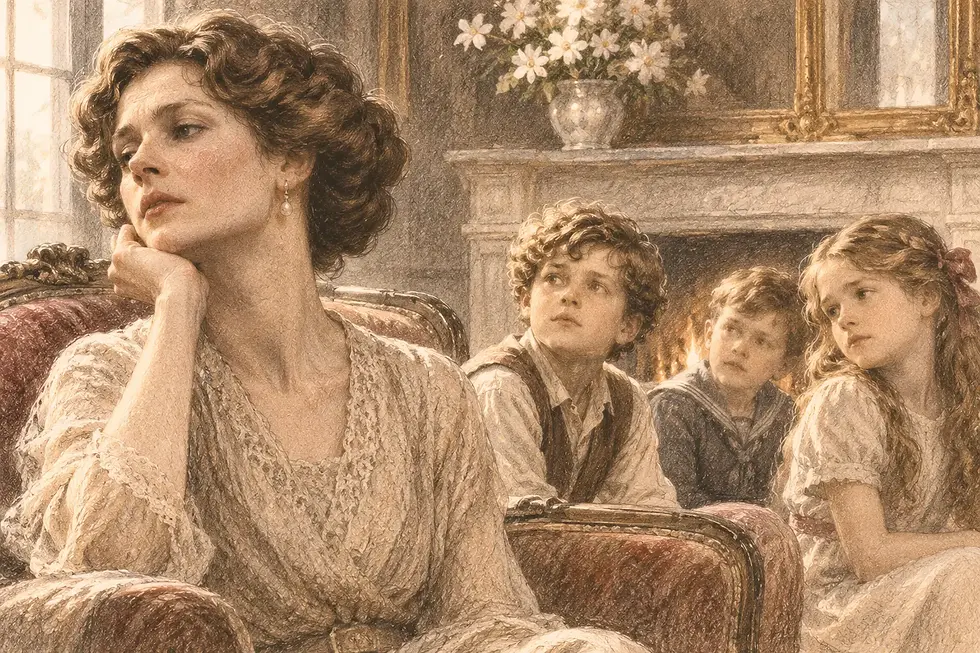
There were a boy and two little girls. They lived in a pleasant house, with a garden, and they had discreet servants, and felt themselves superior to anyone in the neighbourhood.
Although they lived in style, they felt always an anxiety in the house. There was never enough money. The mother had a small income, and the father had a small income, but not nearly enough for the social position which they had to keep up. The father went into town to some office. But though he had good prospects, these prospects never materialised. There was always the grinding sense of the shortage of money, though the style was always kept up.
At last the mother said: "I will see if I can't make something." But she did not know where to begin. She racked her brains, and tried this thing and the other, but could not find anything successful. The failure made deep lines come into her face. Her children were growing up, they would have to go to school. There must be more money, there must be more money. The father, who was always very handsome and expensive in his tastes, seemed as if he never would be able to do anything worth doing. And the mother, who had a great belief in herself, did not succeed any better, and her tastes were just as expensive.
And so the house came to be haunted by the unspoken phrase: There must be more money! There must be more money! The children could hear it all the time though nobody said it aloud. They heard it at Christmas, when the expensive and splendid toys filled the nursery. Behind the shining modern rocking-horse, behind the smart doll's house, a voice would start whispering: "There must be more money! There must be more money!" And the children would stop playing, to listen for a moment. They would look into each other's eyes, to see if they had all heard. And each one saw in the eyes of the other two that they too had heard. "There must be more money! There must be more money!"
It came whispering from the springs of the still-swaying rocking-horse, and even the horse, bending his wooden, champing head, heard it. The big doll, sitting so pink and smirking in her new pram, could hear it quite plainly, and seemed to be smirking all the more self-consciously because of it. The foolish puppy, too, that took the place of the teddy-bear, he was looking so extraordinarily foolish for no other reason but that he heard the secret whisper all over the house: "There must be more money!"
Yet nobody ever said it aloud. The whisper was everywhere, and therefore no one spoke it. Just as no one ever says: "We are breathing!" in spite of the fact that breath is coming and going all the time.
"Mother," said the boy Paul one day, "why don't we keep a car of our own? Why do we always use uncle's, or else a taxi?"
"Because we're the poor members of the family," said the mother.
"But why are we, mother?"
"Well - I suppose," she said slowly and bitterly, "it's because your father has no luck."
The boy was silent for some time.
"Is luck money, mother?" he asked, rather timidly.
"No, Paul. Not quite. It's what causes you to have money."
"Oh!" said Paul vaguely. "I thought when Uncle Oscar said filthy lucker, it meant money."
"Filthy lucre does mean money," said the mother. "But it's lucre, not luck."
"Oh!" said the boy. "Then what is luck, mother?"
"It's what causes you to have money. If you're lucky you have money. That's why it's better to be born lucky than rich. If you're rich, you may lose your money. But if you're lucky, you will always get more money."
"Oh! Will you? And is father not lucky?"
"Very unlucky, I should say," she said bitterly.
The boy watched her with unsure eyes.
"Why?" he asked.
"I don't know. Nobody ever knows why one person is lucky and another unlucky."
"Don't they? Nobody at all? Does nobody know?"
"Perhaps God. But He never tells."
"He ought to, then. And are'nt you lucky either, mother?"
"I can't be, it I married an unlucky husband."
"But by yourself, aren't you?"
"I used to think I was, before I married. Now I think I am very unlucky indeed."
"Why?"
"Well - never mind! Perhaps I'm not really," she said.
The child looked at her to see if she meant it. But he saw, by the lines of her mouth, that she was only trying to hide something from him.
"Well, anyhow," he said stoutly, "I'm a lucky person."
"Why?" said his mother, with a sudden laugh.
He stared at her. He didn't even know why he had said it.
"God told me," he asserted, brazening it out.
"I hope He did, dear!", she said, again with a laugh, but rather bitter.
"He did, mother!"
"Excellent!" said the mother, using one of her husband's exclamations.
The boy saw she did not believe him; or rather, that she paid no attention to his assertion. This angered him somewhere, and made him want to compel her attention.
He went off by himself, vaguely, in a childish way, seeking for the clue to 'luck'. Absorbed, taking no heed of other people, he went about with a sort of stealth, seeking inwardly for luck. He wanted luck, he wanted it, he wanted it. When the two girls were playing dolls in the nursery, he would sit on his big rocking-horse, charging madly into space, with a frenzy that made the little girls peer at him uneasily. Wildly the horse careered, the waving dark hair of the boy tossed, his eyes had a strange glare in them. The little girls dared not speak to him.

When he had ridden to the end of his mad little journey, he climbed down and stood in front of his rocking-horse, staring fixedly into its lowered face. Its red mouth was slightly open, its big eye was wide and glassy-bright.
"Now!" he would silently command the snorting steed. "Now take me to where there is luck! Now take me!"
And he would slash the horse on the neck with the little whip he had asked Uncle Oscar for. He knew the horse could take him to where there was luck, if only he forced it. So he would mount again and start on his furious ride, hoping at last to get there.
"You'll break your horse, Paul!" said the nurse.
"He's always riding like that! I wish he'd leave off!" said his elder sister Joan.
But he only glared down on them in silence. Nurse gave him up. She could make nothing of him. Anyhow, he was growing beyond her.
One day his mother and his Uncle Oscar came in when he was on one of his furious rides. He did not speak to them.
"Hallo, you young jockey! Riding a winner?" said his uncle.
"Aren't you growing too big for a rocking-horse? You're not a very little boy any longer, you know," said his mother.
But Paul only gave a blue glare from his big, rather close-set eyes. He would speak to nobody when he was in full tilt. His mother watched him with an anxious expression on her face.
At last he suddenly stopped forcing his horse into the mechanical gallop and slid down.
"Well, I got there!" he announced fiercely, his blue eyes still flaring, and his sturdy long legs straddling apart.
"Where did you get to?" asked his mother.
"Where I wanted to go," he flared back at her.
"That's right, son!" said Uncle Oscar. "Don't you stop till you get there. What's the horse's name?"
"He doesn't have a name," said the boy.
"Get's on without all right?" asked the uncle.
"Well, he has different names. He was called Sansovino last week."
"Sansovino, eh? Won the Ascot. How did you know this name?"
"He always talks about horse-races with Bassett," said Joan.
The uncle was delighted to find that his small nephew was posted with all the racing news. Bassett, the young gardener, who had been wounded in the left foot in the war and had got his present job through Oscar Cresswell, whose batman he had been, was a perfect blade of the 'turf'. He lived in the racing events, and the small boy lived with him.
Oscar Cresswell got it all from Bassett.
"Master Paul comes and asks me, so I can't do more than tell him, sir," said Bassett, his face terribly serious, as if he were speaking of religious matters.
"And does he ever put anything on a horse he fancies?"
"Well - I don't want to give him away - he's a young sport, a fine sport, sir. Would you mind asking him himself? He sort of takes a pleasure in it, and perhaps he'd feel I was giving him away, sir, if you don't mind.
Bassett was serious as a church.
The uncle went back to his nephew and took him off for a ride in the car.
"Say, Paul, old man, do you ever put anything on a horse?" the uncle asked.
The boy watched the handsome man closely.
"Why, do you think I oughtn't to?" he parried.
"Not a bit of it! I thought perhaps you might give me a tip for the Lincoln."
The car sped on into the country, going down to Uncle Oscar's place in Hampshire.
"Honour bright?" said the nephew.
"Honour bright, son!" said the uncle.
"Well, then, Daffodil."
"Daffodil! I doubt it, sonny. What about Mirza?"
"I only know the winner," said the boy. "That's Daffodil."
"Daffodil, eh?"
There was a pause. Daffodil was an obscure horse comparatively.
"Uncle!"
"Yes, son?"
"You won't let it go any further, will you? I promised Bassett."
"Bassett be damned, old man! What's he got to do with it?"
"We're partners. We've been partners from the first. Uncle, he lent me my first five shillings, which I lost. I promised him, honour bright, it was only between me and him; only you gave me that ten-shilling note I started winning with, so I thought you were lucky. You won't let it go any further, will you?"
The boy gazed at his uncle from those big, hot, blue eyes, set rather close together. The uncle stirred and laughed uneasily.
"Right you are, son! I'll keep your tip private. How much are you putting on him?"
"All except twenty pounds," said the boy. "I keep that in reserve."
The uncle thought it a good joke.
"You keep twenty pounds in reserve, do you, you young romancer? What are you betting, then?"
"I'm betting three hundred," said the boy gravely. "But it's between you and me, Uncle Oscar! Honour bright?"
"It's between you and me all right, you young Nat Gould," he said, laughing. "But where's your three hundred?"
"Bassett keeps it for me. We're partner's."
"You are, are you! And what is Bassett putting on Daffodil?"
"He won't go quite as high as I do, I expect. Perhaps he'll go a hundred and fifty."
"What, pennies?" laughed the uncle.
"Pounds," said the child, with a surprised look at his uncle. "Bassett keeps a bigger reserve than I do."
Between wonder and amusement Uncle Oscar was silent. He pursued the matter no further, but he determined to take his nephew with him to the Lincoln races.
"Now, son," he said, "I'm putting twenty on Mirza, and I'll put five on for you on any horse you fancy. What's your pick?"
"Daffodil, uncle."
"No, not the fiver on Daffodil!"
"I should if it was my own fiver," said the child.
"Good! Good! Right you are! A fiver for me and a fiver for you on Daffodil."
The child had never been to a race-meeting before, and his eyes were blue fire. He pursed his mouth tight and watched. A Frenchman just in front had put his money on Lancelot. Wild with excitement, he flayed his arms up and down, yelling "Lancelot!, Lancelot!" in his French accent.
Daffodil came in first, Lancelot second, Mirza third. The child, flushed and with eyes blazing, was curiously serene. His uncle brought him four five-pound notes, four to one.
"What am I to do with these?" he cried, waving them before the boys eyes.
"I suppose we'll talk to Bassett," said the boy. "I expect I have fifteen hundred now; and twenty in reserve; and this twenty."
His uncle studied him for some moments.
"Look here, son!" he said. "You're not serious about Bassett and that fifteen hundred, are you?"
"Yes, I am. But it's between you and me, uncle. Honour bright?"
"Honour bright all right, son! But I must talk to Bassett."
"If you'd like to be a partner, uncle, with Bassett and me, we could all be partners. Only, you'd have to promise, honour bright, uncle, not to let it go beyond us three. Bassett and I are lucky, and you must be lucky, because it was your ten shillings I started winning with ..."
Uncle Oscar took both Bassett and Paul into Richmond Park for an afternoon, and there they talked.
"It's like this, you see, sir," Bassett said. "Master Paul would get me talking about racing events, spinning yarns, you know, sir. And he was always keen on knowing if I'd made or if I'd lost. It's about a year since, now, that I put five shillings on Blush of Dawn for him: and we lost. Then the luck turned, with that ten shillings he had from you: that we put on Singhalese. And since that time, it's been pretty steady, all things considering. What do you say, Master Paul?"
"We're all right when we're sure," said Paul. "It's when we're not quite sure that we go down."
"Oh, but we're careful then," said Bassett.
"But when are you sure?" smiled Uncle Oscar.
"It's Master Paul, sir," said Bassett in a secret, religious voice. "It's as if he had it from heaven. Like Daffodil, now, for the Lincoln. That was as sure as eggs."
"Did you put anything on Daffodil?" asked Oscar Cresswell.
"Yes, sir, I made my bit."
"And my nephew?"
Bassett was obstinately silent, looking at Paul.
"I made twelve hundred, didn't I, Bassett? I told uncle I was putting three hundred on Daffodil."
"That's right," said Bassett, nodding.
"But where's the money?" asked the uncle.
"I keep it safe locked up, sir. Master Paul he can have it any minute he likes to ask for it."
"What, fifteen hundred pounds?"
"And twenty! And forty, that is, with the twenty he made on the course."
"It's amazing!" said the uncle.
"If Master Paul offers you to be partners, sir, I would, if I were you: if you'll excuse me," said Bassett.
Oscar Cresswell thought about it.
"I'll see the money," he said.
They drove home again, and, sure enough, Bassett came round to the garden-house with fifteen hundred pounds in notes. The twenty pounds reserve was left with Joe Glee, in the Turf Commission deposit.
"You see, it's all right, uncle, when I'm sure! Then we go strong, for all we're worth, don't we, Bassett?"
"We do that, Master Paul."
"And when are you sure?" said the uncle, laughing.
"Oh, well, sometimes I'm absolutely sure, like about Daffodil," said the boy; "and sometimes I have an idea; and sometimes I haven't even an idea, have I, Bassett? Then we're careful, because we mostly go down."
"You do, do you! And when you're sure, like about Daffodil, what makes you sure, sonny?"
"Oh, well, I don't know," said the boy uneasily. "I'm sure, you know, uncle; that's all."
"It's as if he had it from heaven, sir," Bassett reiterated.
"I should say so!" said the uncle.

But he became a partner. And when the Leger was coming on Paul was 'sure' about Lively Spark, which was a quite inconsiderable horse. The boy insisted on putting a thousand on the horse, Bassett went for five hundred, and Oscar Cresswell two hundred. Lively Spark came in first, and the betting had been ten to one against him. Paul had made ten thousand.
"You see," he said. "I was absolutely sure of him."
Even Oscar Cresswell had cleared two thousand.
"Look here, son," he said, "this sort of thing makes me nervous."
"It needn't, uncle! Perhaps I shan't be sure again for a long time."
"But what are you going to do with your money?" asked the uncle.
"Of course," said the boy, "I started it for mother. She said she had no luck, because father is unlucky, so I thought if I was lucky, it might stop whispering."
"What might stop whispering?"
"Our house. I hate our house for whispering."
"What does it whisper?"
"Why - why" - the boy fidgeted - "why, I don't know. But it's always short of money, you know, uncle."
"I know it, son, I know it."
"You know people send mother writs, don't you, uncle?"
"I'm afraid I do," said the uncle.
"And then the house whispers, like people laughing at you behind your back. It's awful, that is! I thought if I was lucky -"
"You might stop it," added the uncle.
The boy watched him with big blue eyes, that had an uncanny cold fire in them, and he said never a word.
"Well, then!" said the uncle. "What are we doing?"
"I shouldn't like mother to know I was lucky," said the boy.
"Why not, son?"
"She'd stop me."
"I don't think she would."
"Oh!" - and the boy writhed in an odd way - "I don't want her to know, uncle."
"All right, son! We'll manage it without her knowing."
They managed it very easily. Paul, at the other's suggestion, handed over five thousand pounds to his uncle, who deposited it with the family lawyer, who was then to inform Paul's mother that a relative had put five thousand pounds into his hands, which sum was to be paid out a thousand pounds at a time, on the mother's birthday, for the next five years.
"So she'll have a birthday present of a thousand pounds for five successive years," said Uncle Oscar. "I hope it won't make it all the harder for her later."
Paul's mother had her birthday in November. The house had been 'whispering' worse than ever lately, and, even in spite of his luck, Paul could not bear up against it. He was very anxious to see the effect of the birthday letter, telling his mother about the thousand pounds.
When there were no visitors, Paul now took his meals with his parents, as he was beyond the nursery control. His mother went into town nearly every day. She had discovered that she had an odd knack of sketching furs and dress materials, so she worked secretly in the studio of a friend who was the chief 'artist' for the leading drapers. She drew the figures of ladies in furs and ladies in silk and sequins for the newspaper advertisements. This young woman artist earned several thousand pounds a year, but Paul's mother only made several hundreds, and she was again dissatisfied. She so wanted to be first in something, and she did not succeed, even in making sketches for drapery advertisements.
She was down to breakfast on the morning of her birthday. Paul watched her face as she read her letters. He knew the lawyer's letter. As his mother read it, her face hardened and became more expressionless. Then a cold, determined look came on her mouth. She hid the letter under the pile of others, and said not a word about it.
"Didn't you have anything nice in the post for your birthday, mother?" said Paul.
"Quite moderately nice," she said, her voice cold and hard and absent.
She went away to town without saying more.
But in the afternoon Uncle Oscar appeared. He said Paul's mother had had a long interview with the lawyer, asking if the whole five thousand could not be advanced at once, as she was in debt.
"What do you think, uncle?" said the boy.
"I leave it to you, son."
"Oh, let her have it, then! We can get some more with the other," said the boy.
"A bird in the hand is worth two in the bush, laddie!" said Uncle Oscar.
"But I'm sure to know for the Grand National; or the Lincolnshire; or else the Derby. I'm sure to know for one of them," said Paul.
So Uncle Oscar signed the agreement, and Paul's mother touched the whole five thousand. Then something very curious happened. The voices in the house suddenly went mad, like a chorus of frogs on a spring evening. There were certain new furnishings, and Paul had a tutor. He was really going to Eton, his father's school, in the following autumn. There were flowers in the winter, and a blossoming of the luxury Paul's mother had been used to. And yet the voices in the house, behind the sprays of mimosa and almond-blossom, and from under the piles of iridescent cushions, simply trilled and screamed in a sort of ecstasy: "There must be more money! Oh-h-h; there must be more money. Oh, now, now-w! Now-w-w - there must be more money! - more than ever! More than ever!"
It frightened Paul terribly. He studied away at his Latin and Greek with his tutor. But his intense hours were spent with Bassett. The Grand National had gone by: he had not 'known', and had lost a hundred pounds. Summer was at hand. He was in agony for the Lincoln. But even for the Lincoln he didn't 'know', and he lost fifty pounds. He became wild-eyed and strange, as if something were going to explode in him.
"Let it alone, son! Don't you bother about it!" urged Uncle Oscar. But it was as if the boy couldn't really hear what his uncle was saying.
"I've got to know for the Derby! I've got to know for the Derby!" the child reiterated, his big blue eyes blazing with a sort of madness.
His mother noticed how overwrought he was.
"You'd better go to the seaside. Wouldn't you like to go now to the seaside, instead of waiting? I think you'd better," she said, looking down at him anxiously, her heart curiously heavy because of him.
But the child lifted his uncanny blue eyes.
"I couldn't possibly go before the Derby, mother!" he said. "I couldn't possibly!"
"Why not?" she said, her voice becoming heavy when she was opposed. "Why not? You can still go from the seaside to see the Derby with your Uncle Oscar, if that that's what you wish. No need for you to wait here. Besides, I think you care too much about these races. It's a bad sign. My family has been a gambling family, and you won't know till you grow up how much damage it has done. But it has done damage. I shall have to send Bassett away, and ask Uncle Oscar not to talk racing to you, unless you promise to be reasonable about it: go away to the seaside and forget it. You're all nerves!"
"I'll do what you like, mother, so long as you don't send me away till after the Derby," the boy said.
"Send you away from where? Just from this house?"
"Yes," he said, gazing at her.
"Why, you curious child, what makes you care about this house so much, suddenly? I never knew you loved it."
He gazed at her without speaking. He had a secret within a secret, something he had not divulged, even to Bassett or to his Uncle Oscar.
But his mother, after standing undecided and a little bit sullen for some moments, said: "Very well, then! Don't go to the seaside till after the Derby, if you don't wish it. But promise me you won't think so much about horse-racing and events as you call them!"
"Oh no," said the boy casually. "I won't think much about them, mother. You needn't worry. I wouldn't worry, mother, if I were you."
"If you were me and I were you," said his mother, "I wonder what we should do!"
"But you know you needn't worry, mother, don't you?" the boy repeated.
"I should be awfully glad to know it," she said wearily.
"Oh, well, you can, you know. I mean, you ought to know you needn't worry," he insisted.
"Ought I? Then I'll see about it," she said.
Paul's secret of secrets was his wooden horse, that which had no name. Since he was emancipated from a nurse and a nursery-governess, he had had his rocking-horse removed to his own bedroom at the top of the house.
"Surely you're too big for a rocking-horse!" his mother had remonstrated.
"Well, you see, mother, till I can have a real horse, I like to have some sort of animal about," had been his quaint answer.
"Do you feel he keeps you company?" she laughed.
"Oh yes! He's very good, he always keeps me company, when I'm there," said Paul.
So the horse, rather shabby, stood in an arrested prance in the boy's bedroom.
The Derby was drawing near, and the boy grew more and more tense. He hardly heard what was spoken to him, he was very frail, and his eyes were really uncanny. His mother had sudden strange seizures of uneasiness about him. Sometimes, for half an hour, she would feel a sudden anxiety about him that was almost anguish. She wanted to rush to him at once, and know he was safe.
Two nights before the Derby, she was at a big party in town, when one of her rushes of anxiety about her boy, her first-born, gripped her heart till she could hardly speak. She fought with the feeling, might and main, for she believed in common sense. But it was too strong. She had to leave the dance and go downstairs to telephone to the country. The children's nursery-governess was terribly surprised and startled at being rung up in the night.
"Are the children all right, Miss Wilmot?"
"Oh yes, they are quite all right."
"Master Paul? Is he all right?"
"He went to bed as right as a trivet. Shall I run up and look at him?"
"No," said Paul's mother reluctantly. "No! Don't trouble. It's all right. Don't sit up. We shall be home fairly soon." She did not want her son's privacy intruded upon.
"Very good," said the governess.
It was about one o'clock when Paul's mother and father drove up to their house. All was still. Paul's mother went to her room and slipped off her white fur cloak. She had told her maid not to wait up for her. She heard her husband downstairs, mixing a whisky and soda.
And then, because of the strange anxiety at her heart, she stole upstairs to her son's room. Noiselessly she went along the upper corridor. Was there a faint noise? What was it?
She stood, with arrested muscles, outside his door, listening. There was a strange, heavy, and yet not loud noise. Her heart stood still. It was a soundless noise, yet rushing and powerful. Something huge, in violent, hushed motion. What was it? What in God's name was it? She ought to know. She felt that she knew the noise. She knew what it was.
Yet she could not place it. She couldn't say what it was. And on and on it went, like a madness.
Softly, frozen with anxiety and fear, she turned the door-handle.
The room was dark. Yet in the space near the window, she heard and saw something plunging to and fro. She gazed in fear and amazement.
Then suddenly she switched on the light, and saw her son, in his green pyjamas, madly surging on the rocking-horse. The blaze of light suddenly lit him up, as he urged the wooden horse, and lit her up, as she stood, blonde, in her dress of pale green and crystal, in the doorway.
"Paul!" she cried. "Whatever are you doing?"
"It's Malabar!" he screamed in a powerful, strange voice. "It's Malabar!"
His eyes blazed at her for one strange and senseless second, as he ceased urging his wooden horse. Then he fell with a crash to the ground, and she, all her tormented motherhood flooding upon her, rushed to gather him up.
But he was unconscious, and unconscious he remained, with some brain-fever. He talked and tossed, and his mother sat stonily by his side.
"Malabar! It's Malabar! Bassett, Bassett, I know! It's Malabar!"
So the child cried, trying to get up and urge the rocking-horse that gave him his inspiration.
"What does he mean by Malabar?" asked the heart-frozen mother.
"I don't know," said the father stonily.
"What does he mean by Malabar?" she asked her brother Oscar.
"It's one of the horses running for the Derby," was the answer.
And, in spite of himself, Oscar Cresswell spoke to Bassett, and himself put a thousand on Malabar: at fourteen to one.
The third day of the illness was critical: they were waiting for a change. The boy, with his rather long, curly hair, was tossing ceaselessly on the pillow. He neither slept nor regained consciousness, and his eyes were like blue stones. His mother sat, feeling her heart had gone, turned actually into a stone.
In the evening Oscar Cresswell did not come, but Bassett sent a message, saying could he come up for one moment, just one moment? Paul's mother was very angry at the intrusion, but on second thoughts she agreed. The boy was the same. Perhaps Bassett might bring him to consciousness.
The gardener, a shortish fellow with a little brown moustache and sharp little brown eyes, tiptoed into the room, touched his imaginary cap to Paul's mother, and stole to the bedside, staring with glittering, smallish eyes at the tossing, dying child.
"Master Paul!" he whispered. "Master Paul! Malabar came in first all right, a clean win. I did as you told me. You've made over seventy thousand pounds, you have; you've got over eighty thousand. Malabar came in all right, Master Paul."
"Malabar! Malabar! Did I say Malabar, mother? Did I say Malabar? Do you think I'm lucky, mother? I knew Malabar, didn't I? Over eighty thousand pounds! I call that lucky, don't you, mother? Over eighty thousand pounds! I knew, didn't I know I knew? Malabar came in all right. If I ride my horse till I'm sure, then I tell you, Bassett, you can go as high as you like. Did you go for all you were worth, Bassett?"
"I went a thousand on it, Master Paul."
"I never told you, mother, that if I can ride my horse, and get there, then I'm absolutely sure - oh, absolutely! Mother, did I ever tell you? I am lucky!"
"No, you never did," said his mother.
But the boy died in the night.
And even as he lay dead, his mother heard her brother's voice saying to her, "My God, Hester, you're eighty-odd thousand to the good, and a poor devil of a son to the bad. But, poor devil, poor devil, he's best gone out of a life where he rides his rocking-horse to find a winner."
Part I: Fantasy, the Supernatural, and the Uncanny
The house in “The Rocking-Horse Winner” is filled with expensive furnishings, toys, and the comforts of a prosperous household. Yet its inhabitants remain troubled by a sense that they do not have enough money. The dissatisfaction is never openly discussed in front of the children, but they become aware of it. Before long, the house itself seems to repeat the family's unspoken concern:
“There must be more money! There must be more money!”
No one can identify a speaker. The words seem to come from the rooms, the furnishings, and the children's toys. The house has not visibly changed, yet it no longer appears entirely ordinary. Something that should remain silent seems to have acquired a voice.
Lawrence introduces this disturbance without explaining its cause. The whispering may express the children's awareness of their parents' financial anxieties. It may also suggest that an unseen force has entered the household. Both possibilities remain available, and the story gradually introduces other events that resist ordinary explanation.
These events bring three related literary concepts into view: fantasy, the supernatural, and the uncanny. Each helps explain a different aspect of Lawrence's treatment of the extraordinary.
Fantasy: The Impossible Within the Ordinary
Paul's rocking horse is an ordinary nursery toy. It moves backwards and forwards without travelling anywhere, allowing a child to imagine a journey while remaining in the same room. Nothing about the object initially suggests that it possesses an unusual power.
Paul, however, rides the horse with a purpose that goes beyond ordinary play. He believes that by riding hard enough, he can reach a mysterious destination where he will discover the name of a winning racehorse. His movements become increasingly intense, and he sometimes continues until he reaches a state of exhaustion.
The extraordinary feature of these rides is not the movement of the horse. The toy remains stationary. It is the apparent knowledge Paul obtains through the experience.
Paul begins predicting the winners of actual horse races. His predictions are not always certain, but when he declares himself sure of a particular horse, his judgment repeatedly proves correct. Bassett, the gardener who helps him place bets, comes to regard this certainty with unusual respect.
The story therefore places an apparently impossible ability within a recognizable world. The races are ordinary sporting events, the bets involve real money, and Paul's winnings affect the family's financial circumstances. Only the means by which he discovers the winners remain unexplained.
This combination of the ordinary and the impossible is one way fantasy operates in literature.
Fantasy introduces elements that exceed the established possibilities of everyday experience. These elements may involve magical objects, extraordinary abilities, impossible transformations, or entire worlds governed by unfamiliar laws.
Some works of fantasy establish a separate world in which extraordinary events are accepted as normal. Lewis Carroll's Alice's Adventures in Wonderland, for example, presents a world where animals speak, bodies change size, and familiar rules of logic no longer apply consistently.
Other works retain an ordinary setting and introduce extraordinary events into it. Lawrence follows this second approach. Paul's apparent gift does not belong to a world where magic is openly acknowledged. It emerges in a household governed by familiar concerns about money, reputation, and social position.
The distinction affects how readers respond. In Wonderland, extraordinary events form part of the world Alice enters. In “The Rocking-Horse Winner,” Paul's ability remains unusual because the surrounding world continues to operate according to ordinary expectations.
Fantasy, then, does not require a completely imaginary setting. It may arise from a single departure from ordinary possibility, particularly when that departure changes the meaning of otherwise familiar events.
Lawrence uses this departure to connect Paul's desire for money with an ability that seems capable of satisfying it. The fantastic element does not remove the family's problems. It becomes part of the child's attempt to solve them.
The Supernatural: An Unexplained Source of Knowledge
Paul's success at predicting races raises a difficulty that the story never resolves. His knowledge appears to be reliable under certain conditions, yet he cannot explain how he acquires it.
When Paul is uncertain about a horse, he does not claim to possess the answer. When he becomes certain, however, he treats that knowledge as something beyond ordinary judgment. His uncle and Bassett gradually recognize the difference because the results appear to confirm it.
The source of Paul's certainty is especially unusual. He does not obtain his information through careful study of racing records or through conversations with experienced gamblers. Instead, his knowledge seems connected with the intense experience of riding his rocking horse.
The possibility that Paul possesses a power beyond natural explanation introduces the supernatural.
The supernatural concerns events or abilities that appear to operate outside the known laws of nature. Ghosts, prophetic visions, communication with the dead, and inexplicable knowledge of future events are familiar examples. Such occurrences suggest that forces beyond ordinary physical explanation may influence the world.
Fantasy and the supernatural frequently overlap. The distinction lies partly in what each term describes. Fantasy refers broadly to the presence of the impossible or extraordinary in an imagined world. The supernatural concerns powers or occurrences that seem to transcend natural explanation.
Paul's apparent ability to foresee race results belongs to both categories. It is fantastic because it exceeds ordinary human capabilities. It appears supernatural because it suggests access to knowledge that should not yet be available.
Lawrence nevertheless avoids establishing a definite explanation.
Paul may possess an extraordinary power. His rides may also represent a form of psychological compulsion through which his desire for certainty becomes concentrated in a physical ritual. The narrative provides evidence of his emotional distress without explaining away the unusual accuracy of his predictions.
This distinction deserves attention. Paul's psychological condition helps explain why he seeks certainty, but it does not fully explain how his predictions succeed. The story presents the results of his apparent gift while withholding a reliable account of its source.
A supernatural interpretation is therefore possible, but not conclusively established.
This uncertainty distinguishes Lawrence's treatment of the extraordinary from stories in which supernatural powers are openly confirmed. The reader is not given a set of magical rules that explains Paul's ability. Instead, the extraordinary remains closely connected with experiences that can also be understood psychologically.
The supernatural becomes significant not simply because Paul seems to predict the future, but because his unexplained ability gives him a means of pursuing something he cannot obtain through ordinary family relationships.
The Uncanny: When Familiar Things Become Unsettling
The rocking horse is not the only ordinary object that acquires an unusual significance. The house itself seems to speak, the nursery becomes the setting for Paul's increasingly exhausting rides, and the children's awareness of their mother's dissatisfaction develops into a persistent sense of unease.
None of these familiar surroundings disappears or undergoes a complete transformation. The house remains a house, and the rocking horse remains a toy. Their disturbing qualities arise from the meanings and experiences associated with them.
This effect is often described as the uncanny.
The uncanny occurs when something familiar acquires a strange or unsettling quality. Unlike an encounter with something entirely unknown, the uncanny involves a disturbance within what we already recognize. An ordinary object, place, or experience becomes difficult to understand in its accustomed way.
A lifelike doll offers a simple example. Its resemblance to a human being may initially seem familiar, but the same resemblance can become disturbing when the doll appears almost alive without actually being so. The uncertainty arises from the uneasy relationship between the familiar appearance and the unfamiliar impression it creates.
The uncanny is therefore not identical to the supernatural. A supernatural event may be uncanny, but an experience can become uncanny without any supernatural event occurring.
In his essay “The Uncanny” (1919), Sigmund Freud explored this relationship between familiarity and strangeness. He examined the German word unheimlich in relation to heimlich, a term associated with what is familiar, homely, private, or concealed.
Freud's discussion suggests that the uncanny is not merely a response to unfamiliar things. It may arise when something once familiar appears in a disturbing form, or when something ordinarily concealed becomes unexpectedly apparent.
Lawrence's story offers several examples of this experience.
The Whispering House
The family home would ordinarily suggest privacy, comfort, and protection. Lawrence's opening description, however, establishes a difference between the household's outward appearance and the emotional life of its inhabitants.
The family maintains a comfortable lifestyle but remains dissatisfied. The mother feels that she has married an unlucky man, and the children sense that their parents' circumstances are troubled by something they cannot fully understand.
The repeated demand for money gives this dissatisfaction an unusual form.
“There must be more money!”
The words seem to come from the house itself. The children hear the demand in the atmosphere surrounding them, although the adults do not openly acknowledge it.
The house becomes uncanny because a familiar domestic environment appears to express an anxiety that its inhabitants cannot escape.
The whispering need not be understood as a literal supernatural voice. Lawrence may be giving an audible form to the financial pressure that dominates the family's emotional life. The children experience this pressure so persistently that it seems to belong to the house rather than to any individual person.
The distinction remains unresolved. What matters is that the house no longer provides a sense of security. Its apparent voice repeats the demand that governs the family's relationships.
The Rocking Horse
A rocking horse ordinarily belongs to childhood imagination. Its movement imitates travel, but the child remains safely within the nursery. The activity offers the pleasure of an imagined journey without the dangers of an actual one.
Paul's relationship with his horse gradually reverses these expectations.
He does not ride simply for amusement. His movements become increasingly forceful, and his attention is directed toward obtaining a particular kind of knowledge. The imagined journey acquires a purpose that is difficult to separate from the family's financial concerns.
The horse remains physically unchanged. Its significance changes because Paul begins to use it as an instrument for discovering winning racehorses.
This transformation is central to the uncanny effect.
An object associated with play becomes connected with secrecy, exhaustion, and the pursuit of money. The nursery, which should offer a place apart from adult responsibilities, becomes the setting in which those responsibilities take their most disturbing form.
Lawrence does not establish that the rocking horse itself possesses magical powers. The extraordinary element lies in Paul's apparent ability and the relationship between that ability and his rides.
The horse becomes uncanny because it remains recognizable as a child's toy while acquiring a function that seems entirely foreign to childhood.
The Mother and the Absence of Love
The story's unsettling atmosphere also develops through the relationship between Paul and his mother.
At the beginning, the narrator describes a woman who appears to be a devoted mother but privately feels that she cannot love her children as she believes she should. She performs the expected duties of motherhood, yet the children sense a difference between her outward behaviour and her feelings.
The contradiction is not supernatural. It belongs to the emotional life of the family.
Its effect, however, resembles the estrangement found elsewhere in the story. A familiar relationship becomes uncertain because its outward appearance does not correspond to the experience beneath it.
Paul gradually associates his mother's unhappiness with the family's lack of money. When she explains that luck is what causes people to have money, he begins to believe that becoming lucky may provide what the household needs.
His pursuit of luck is therefore connected with a desire that money alone cannot satisfy.
The mother's affection appears to Paul as something uncertain. His extraordinary ability seems to offer a way of making himself valuable within a household where financial success has acquired unusual importance.
The uncanny quality of the story extends beyond its mysterious objects. It emerges from the way ordinary family relationships become governed by expectations that the child cannot fully understand.
Fantasy, the Supernatural, and the Uncanny: Understanding the Difference
The three concepts help explain different features of the same narrative, but they should not be treated as interchangeable.
Fantasy describes the departure from ordinary possibility. Paul's apparent ability to discover winning racehorses through his rides introduces an extraordinary element into an otherwise recognizable world.
The supernatural concerns the possible source of that ability. Paul's predictions suggest access to knowledge beyond ordinary human experience, although the story does not establish how he obtains it.
The uncanny describes the unsettling transformation of familiar experiences. The house seems to whisper, the rocking horse acquires an unexpected purpose, and the nursery becomes associated with anxiety rather than play.
A single event may involve more than one of these effects.
Paul's rides are fantastic because they appear to produce impossible knowledge. They suggest the supernatural because the source of that knowledge remains unexplained. They are uncanny because an ordinary childhood activity becomes increasingly disturbing.
The distinction becomes clearer when we consider the house.
Its whispering may suggest a supernatural presence, but the story does not require that interpretation. Even if the words are understood as an expression of the children's anxiety, the house remains uncanny because its familiar surroundings seem to communicate an unspoken demand.
The supernatural depends upon the possibility of forces beyond nature. The uncanny depends upon a disturbance in our experience of what is familiar. Fantasy provides the broader imaginative setting in which such possibilities may appear.
Recognizing these differences allows readers to describe Lawrence's methods more precisely without reducing the story to a single explanation.
The Purpose of the Extraordinary
Paul believes that luck will provide the money his family needs. His unusual ability appears to confirm this belief. By predicting winning horses, he acquires wealth that would otherwise remain beyond his reach.
The money, however, does not produce the result he expects.
When his mother receives a substantial sum, her desire for more money becomes stronger. The house's demand intensifies rather than disappears. Paul's apparent success therefore fails to resolve the dissatisfaction that first encouraged him to seek luck.
This development changes the significance of his extraordinary ability.
What initially appears to offer a solution becomes part of the problem. Paul continues pursuing certainty because each success leaves the underlying demand unanswered. His gift allows him to obtain money, but it cannot provide the emotional security he seeks.
The story's fantastic elements are therefore closely connected with its treatment of desire.
Lawrence does not introduce the extraordinary simply to create mystery. The whispering house gives form to the family's persistent dissatisfaction. The rocking horse connects childhood imagination with the pressure to obtain wealth. Paul's unexplained knowledge makes it possible for a child to assume responsibility for demands that properly belong to the adult world.
These elements reveal a relationship between the family's ordinary concerns and the disturbing consequences of those concerns.
The final tragedy does not explain the supernatural mystery. Readers still cannot say with certainty how Paul discovers the winning horses. What becomes clearer is why he pursues that knowledge and what the pursuit costs him.
The story leaves the extraordinary unresolved while making its human consequences increasingly apparent. Through fantasy, the supernatural, and the uncanny, Lawrence allows the familiar pressures of money, expectation, and the desire for affection to appear in forms that expose their destructive possibilities.
Part II: Fantasy, the Supernatural, and the Uncanny in Fiction
A man awakens to find that his body has changed into that of an enormous insect-like creature. A prince encounters the ghost of his murdered father. A young man falls in love with a woman who turns out to be a mechanical doll. Each event disturbs an assumption about the world, but the stories in which they occur do not produce the same effect.
In one, an impossible transformation becomes part of everyday life. In another, an encounter with the dead raises questions about truth and deception. In the third, the resemblance between a living person and an artificial figure becomes a source of unease.
Writers have long used such departures from ordinary experience to examine human concerns. The extraordinary may create a new imaginative world, challenge a character's understanding of reality, or make familiar surroundings appear strangely threatening. These different effects help us distinguish fantasy, the supernatural, and the uncanny.
Fantasy: The Boundaries of the Possible
In Lewis Carroll's Alice's Adventures in Wonderland (1865), Alice follows a White Rabbit into a world where animals speak, bodies change size, and familiar rules of behaviour no longer apply. She encounters a caterpillar who gives advice, a Cheshire Cat who disappears while leaving its grin behind, and a Queen who repeatedly demands executions.
Alice finds much of this world confusing. Its inhabitants, however, generally accept its extraordinary conditions. A conversation with an animal requires no special explanation, and changes in physical size become part of Alice's experience.
The reader gradually recognizes that Wonderland operates according to conventions different from those of ordinary life. Events that would be impossible outside the story become possible within it.
This is one of the central features of fantasy. A literary work may establish an imagined reality in which the familiar limitations of nature no longer apply. Its extraordinary elements become part of the world the reader is invited to accept.
Such a world need not be without rules. Even when its events appear unpredictable, readers begin to recognize patterns in the way characters behave and situations develop. Fantasy allows writers to depart from ordinary possibility without abandoning the relationships between actions and consequences upon which narrative depends.
Not all fantasy, however, takes place in a separate imaginary world.
Franz Kafka's The Metamorphosis (1915) begins with Gregor Samsa discovering that he has been transformed into an enormous insect-like creature. Unlike Alice, Gregor has not entered another world. He remains in his bedroom, surrounded by the furniture and possessions of his ordinary life.
His immediate concerns are practical. He worries about arriving late for work, disappointing his employer, and explaining his condition to his family. The extraordinary transformation is presented alongside responsibilities that remain entirely familiar.
Kafka offers no explanation for what has happened. The narrative does not investigate the biological possibility of Gregor's condition. Instead, it follows the consequences of his transformation for his relationships, employment, and place within the family.
The impossible event gradually reveals the fragility of Gregor's ordinary existence. His family initially depends upon his income, but his inability to work changes their treatment of him. As his physical condition separates him from other people, his social and emotional isolation becomes increasingly apparent.
The transformation gives a visible form to a condition that might otherwise remain difficult to represent. Gregor's alienation is no longer merely an experience of consciousness. It has become a physical reality.
Carroll and Kafka illustrate two different uses of fantasy. Wonderland establishes an environment in which extraordinary events belong to the accepted order of things. The Metamorphosis introduces an impossible condition into a recognizable world and examines its consequences.
Fantasy therefore does not require an elaborate imaginary setting. It may depend upon a single event that ordinary experience cannot explain. What matters is how the departure from reality changes the possibilities of the narrative.
The Supernatural: Beyond Natural Explanation
In Shakespeare's Hamlet, the appearance of a ghost introduces a disturbance into the Danish court. The figure resembles the dead king and claims that he was murdered by his brother, who now occupies the throne.
The ghost appears to possess knowledge that the living characters cannot obtain through ordinary means. It also seems capable of crossing the boundary between life and death.
Its appearance suggests the operation of a supernatural power.
The supernatural concerns events or beings that appear to exist beyond the known laws of nature. Ghosts, prophetic visions, communication with the dead, and certain forms of unexplained knowledge are familiar examples. Such occurrences imply that the visible world may be influenced by forces that ordinary observation cannot adequately explain.
The ghost in Hamlet is particularly interesting because its appearance does not settle every question it raises.
Hamlet must determine whether the spirit is truthful. He considers the possibility that it may be a devil attempting to deceive him. Although the apparition resembles his father, its identity and intentions remain uncertain to him.
The supernatural encounter therefore creates a problem of knowledge. Hamlet receives information that may explain his father's death, but he cannot immediately establish whether the source deserves his trust.
The distinction between witnessing an extraordinary event and understanding its meaning is central to the play. The ghost's appearance introduces the supernatural, while Hamlet's uncertainty about its nature shapes his subsequent actions.
Other works make the existence of the supernatural itself uncertain.
In Henry James's The Turn of the Screw (1898), a governess becomes convinced that two deceased former employees continue to exert a harmful influence over the children in her care.
She reports seeing their apparitions and interprets certain aspects of the children's behaviour as evidence that they are aware of these presences. Her account gradually becomes more disturbing as she attempts to protect the children from what she believes to be a supernatural threat.
The reader, however, receives much of the evidence through the governess's own perceptions. Her observations cannot always be separated from the meanings she assigns to them.
The apparitions may be genuine. They may also reflect fears or psychological pressures that affect her interpretation of events. James does not provide an independent explanation that conclusively resolves the uncertainty.
This uncertainty changes the reading experience. A child's silence may suggest innocence or concealment. An apparently ordinary encounter may become threatening because of what the governess believes it reveals.
The supernatural is no longer simply an extraordinary presence within the story. Its possible existence becomes a question that the reader must continually reconsider.
The literary critic Tzvetan Todorov examined this kind of uncertainty in The Fantastic: A Structural Approach to a Literary Genre (1970). He used the term fantastic in a specialized sense to describe the hesitation between natural and supernatural explanations.
A character or reader encounters an event that appears impossible. If the event can be explained through ordinary causes, the supernatural possibility disappears. If supernatural forces are accepted as part of the fictional world, the uncertainty is resolved in another direction.
The fantastic, in Todorov's narrower sense, occupies the interval in which neither explanation has been established.
This critical use of the word differs from the broader meaning of fantasy. Carroll's Wonderland contains impossible events, but readers are not generally expected to decide whether those events have natural explanations. James's novella, by contrast, sustains uncertainty about the reality of its apparent ghosts.
The supernatural may therefore function differently from one work to another. Some narratives establish its presence. Others make the possibility of supernatural intervention a source of uncertainty.
The Uncanny: The Familiar Made Strange
In Edgar Allan Poe's The Fall of the House of Usher (1839), the narrator approaches an old mansion and experiences an immediate sense of unease.
The building possesses recognizable architectural features. Its windows, walls, and surrounding landscape belong to the ordinary physical world. Yet the narrator finds the scene oppressive and struggles to explain the effect it produces upon him.
The house has not yet revealed anything clearly supernatural. Its disturbing quality emerges from the way familiar details are perceived.
As the story develops, the building becomes increasingly associated with the physical and psychological condition of the Usher family. Its decay appears to reflect the deterioration of its inhabitants, while the enclosed atmosphere intensifies the narrator's anxiety.
Poe makes the familiar setting seem threatening without initially requiring an impossible event.
This effect helps explain the uncanny. The uncanny arises when something recognizable acquires an unfamiliar or disturbing quality. It differs from the fear produced by an entirely unknown danger. The object, person, or place remains familiar enough to be identified, but some aspect of it unsettles our ordinary expectations.
A lifelike doll provides a simple example. Its resemblance to a human being may initially appear convincing, but that same resemblance can become disturbing when the observer becomes uncertain about whether it is capable of independent movement or awareness.
The unease emerges from the unstable relationship between what appears familiar and what seems strangely different.
Sigmund Freud examined this experience in his essay The Uncanny (1919). His discussion draws attention to the German word unheimlich and its relationship to heimlich, a term associated with the familiar, the homely, and the concealed.
Freud was interested in experiences that become frightening not because they are entirely unfamiliar, but because they involve something once familiar that has returned in a disturbing form. He also considered the unease produced by repetition, childhood fears, and uncertainty about the distinction between living and lifeless things.
An important example appears in E. T. A. Hoffmann's The Sandman (1816).
The story follows Nathanael, whose childhood experiences have left him with a persistent fear of a threatening figure associated with the Sandman. As an adult, he encounters people and situations that seem connected with these earlier fears.
Nathanael also becomes fascinated by Olimpia, a young woman whose appearance and behaviour attract his attention. He eventually discovers that she is an automaton.
The revelation changes the meaning of his earlier encounters with her. What Nathanael understood as the behaviour of a living person was produced by a mechanical figure.
The unsettling effect depends upon the resemblance between human life and its artificial imitation. Olimpia appears sufficiently human to deceive Nathanael, yet the discovery of her mechanical nature exposes the limits of that resemblance.
Hoffmann's story also connects this uncertainty with Nathanael's recurring childhood fears. Events in his adult life seem to repeat or revive experiences that have never entirely lost their influence over him.
Freud's interpretation of The Sandman places particular emphasis on the recurring threat to Nathanael's eyes and its connection with deeper psychological anxieties. The automaton remains an important feature of the narrative, although Freud does not regard uncertainty about Olimpia's apparent humanity as its principal source of uncanniness.
The story illustrates how several forms of unease may develop together. An apparently human figure proves artificial, childhood fears return in altered circumstances, and familiar experiences acquire threatening associations.
The uncanny does not necessarily depend upon supernatural events. A mechanical doll is not a supernatural being. Its disturbing effect arises from the uncertainty surrounding its resemblance to human life.
The same distinction applies to Poe's house. Its atmosphere becomes unsettling before the reader can establish whether any extraordinary force is present.
The uncanny describes the experience of familiarity becoming strange, rather than a particular category of impossible events.
Distinguishing the Three Concepts
Fantasy, the supernatural, and the uncanny frequently appear together, but each directs attention toward a different feature of a literary work.
Fantasy concerns the possibilities established by the fictional world. It allows events or conditions that exceed the limits of ordinary experience.
The supernatural concerns forces, beings, or abilities that appear to operate beyond natural explanation. Its presence may be confirmed within the narrative or remain uncertain.
The uncanny concerns the reader's or character's experience of something familiar becoming unsettling. It may arise through supernatural events, but it does not require them.
Consider the different effects of the works discussed.
In Alice's Adventures in Wonderland, extraordinary events belong to an imaginative world whose rules differ from those of ordinary experience. The narrative is fantastic without depending primarily upon fear or uncertainty about supernatural forces.
In Hamlet, the ghost introduces the possibility of communication between the living and the dead. The supernatural encounter creates uncertainty about the apparition's identity and intentions.
In The Turn of the Screw, the reader cannot conclusively determine whether the apparent ghosts exist independently of the governess's perceptions. The possibility of the supernatural remains central to the narrative's uncertainty.
In The Sandman, the discovery that Olimpia is an automaton disturbs the distinction between human appearance and artificial imitation. The effect is uncanny even though the figure's mechanical nature provides a natural explanation.
These distinctions do not create rigid boundaries between literary works. A single event may be fantastic, apparently supernatural, and uncanny at the same time.
A ghost appearing in a familiar bedroom, for example, may violate ordinary expectations about death, suggest the existence of supernatural forces, and transform a place associated with safety into a source of fear.
The terms identify different aspects of the same experience. Their value lies in helping readers explain how a narrative produces its effects.
Why Fiction Turns to the Extraordinary
The extraordinary often allows writers to represent experiences that ordinary events cannot express with the same force.
Gregor Samsa's transformation gives physical form to his separation from family and society. The governess's apparent encounters with ghosts make uncertainty about perception central to The Turn of the Screw. Nathanael's fascination with Olimpia exposes the instability of his understanding of human identity.
These works do not use extraordinary events merely to create surprise. Their departures from ordinary reality shape the questions that readers confront.
Fantasy can make familiar assumptions visible by imagining circumstances in which those assumptions no longer apply. The supernatural can challenge the limits of human knowledge and introduce forces that characters cannot fully understand or control. The uncanny can reveal how easily familiar surroundings and relationships become sources of uncertainty.
The significance of these effects depends upon their place within the narrative. An impossible event does not necessarily possess a symbolic meaning, and a supernatural presence need not represent a psychological condition. Some works invite such interpretations; others establish extraordinary events as features of their fictional worlds.
Careful reading begins by observing what the story presents and how its characters respond. Interpretation follows from the relationships among those events, responses, and consequences.
This approach also clarifies the extraordinary elements in The Rocking-Horse Winner. Paul's apparent ability to predict winning horses introduces a possibility beyond ordinary experience. The source of his knowledge remains unexplained, while the familiar objects and relationships surrounding him become increasingly unsettling.
Lawrence connects these effects with the family's pursuit of money and Paul's desire for his mother's affection. The extraordinary events do not resolve the family's difficulties. Instead, they make the consequences of those difficulties more visible.
Fantasy, the supernatural, and the uncanny offer different ways of extending fiction beyond the limits of ordinary experience. Their literary significance emerges not simply from the presence of the impossible or unexplained, but from what those departures allow readers to recognize about the world the story presents.
✧ ✦ ✧ ✦ ✧ ✦ ✧


Comments