
Araby by James Joyce: Full Illustrated Text and Analysis of Theme in Fiction
In James Joyce’s “Araby,” a young boy becomes fascinated with his friend’s sister and begins to imagine that a visit to a bazaar might allow him to express his feelings for her. The prospect of this journey gradually occupies his thoughts, giving an ordinary event an importance that seems far greater than its purpose. When the evening finally arrives, the experience challenges the expectations he has built around it.
First published in Dubliners (1914), “Araby” is set in early twentieth-century Dublin, where the narrator’s life unfolds among quiet streets, dark houses, and familiar routines. His attraction to Mangan’s sister offers an imagined escape from these surroundings. He begins to associate her with beauty and devotion, investing their limited encounters with a significance she may not share. The bazaar, with its unfamiliar name and promise of exotic goods, becomes another object of his imagination.
As the story progresses, a contrast emerges between the world the narrator constructs through his desires and the reality he eventually encounters. His romantic expectations shape his understanding of ordinary experiences, while delays, indifference, and disappointment gradually expose their limitations. This developing conflict contributes to the story’s central theme of disillusionment: the painful recognition that reality may differ considerably from the ideals through which we perceive it.
Joyce develops this theme through the relationship between character, setting, imagery, and narrative structure. The religious language associated with the boy’s feelings, the recurring contrast between light and darkness, and the difference between the imagined and actual bazaar all contribute to the story’s meaning. By examining how these elements work together, readers can understand how a literary theme develops through the events and details of a narrative rather than appearing simply as a stated lesson.
James Joyce (1882–1941)

❦ Five Things to Know
✠ Born in Rathgar, Dublin, Ireland, in 1882, into a Catholic family whose declining financial circumstances influenced his early life.
✠ Educated at Jesuit schools and University College Dublin, where he studied modern languages and developed an early interest in European literature, particularly the drama of Henrik Ibsen.
✠ Left Ireland with Nora Barnacle in 1904 and spent much of his adult life in European cities, including Trieste, Zurich, and Paris, although Dublin remained central to his fiction.
✠ Published Dubliners (1914), a collection of fifteen short stories exploring the lives, frustrations, and aspirations of Dublin's inhabitants.
✠ Became a leading figure of literary modernism through works such as A Portrait of the Artist as a Young Man (1916), Ulysses (1922), and Finnegans Wake (1939).
❦ His Writing Style
James Joyce explored the relationship between everyday experience and the inner lives of his characters. His early fiction combines precise descriptions of ordinary settings with close attention to memory, desire, and perception. Rather than explaining characters' feelings directly, he often reveals their significance through imagery, dialogue, and moments of sudden recognition, commonly called epiphanies. In stories such as Araby, apparently simple experiences expose the distance between personal expectations and the realities of the surrounding world. His later works developed increasingly experimental approaches to language, narrative structure, and the representation of consciousness. In Ulysses (1922), Joyce follows the experiences of several characters over a single day in Dublin, using interior monologue, shifting narrative styles, and parallels with Homer’s Odyssey to explore the complexity of ordinary life. In Finnegans Wake (1939), he extends his experiments with language even further, creating a densely layered narrative of dreams, history, and recurring human experiences through multilingual wordplay, invented expressions, and unconventional syntax.
⁂ More Short Stories by James Joyce
The Sisters
Eveline
The Dead
❝ Memorable Quote
“A man of genius makes no mistakes. His errors are volitional and are the portals of discovery.”
— Stephen Dedalus in James Joyce's Ulysses (1922), Episode 9, “Scylla and Charybdis”
Araby
by James Joyce (1914)
North Richmond Street, being blind, was a quiet street except at the hour when the Christian Brothers' School set the boys free. An uninhabited house of two storeys stood at the blind end, detached from its neighbours in a square ground. The other houses of the street, conscious of decent lives within them, gazed at one another with brown imperturbable faces.
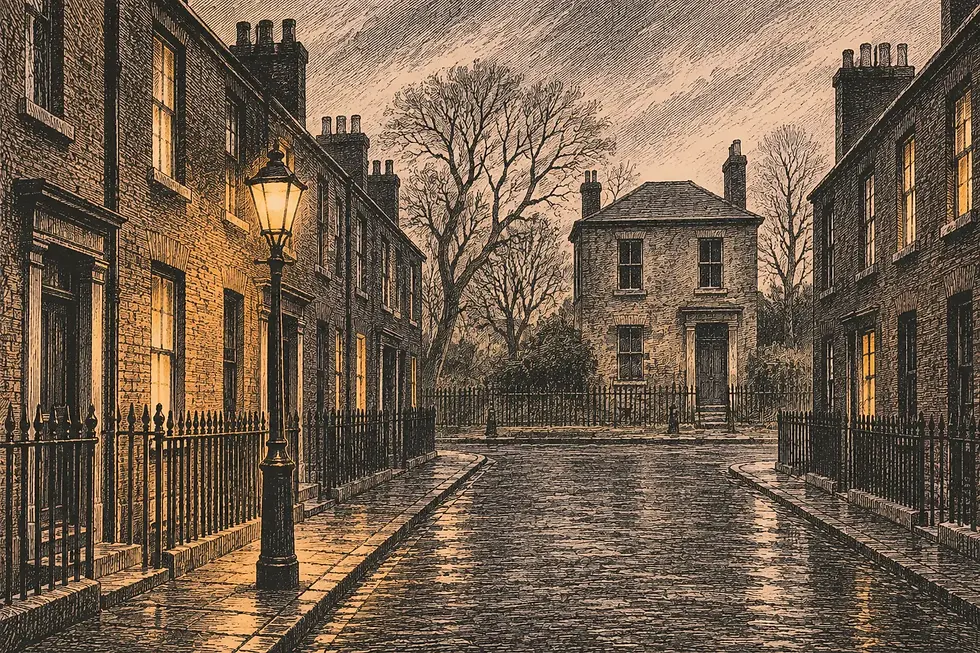
The former tenant of our house, a priest, had died in the back drawing-room. Air, musty from having been long enclosed, hung in all the rooms, and the waste room behind the kitchen was littered with old useless papers. Among these I found a few paper-covered books, the pages of which were curled and damp: The Abbot, by Walter Scott, The Devout Communicant, and The Memoirs of Vidocq. I liked the last best because its leaves were yellow. The wild garden behind the house contained a central apple-tree and a few straggling bushes, under one of which I found the late tenant's rusty bicycle-pump. He had been a very charitable priest; in his will he had left all his money to institutions and the furniture of his house to his sister.
When the short days of winter came, dusk fell before we had well eaten our dinners. When we met in the street the houses had grown sombre. The space of sky above us was the colour of ever-changing violet and towards it the lamps of the street lifted their feeble lanterns. The cold air stung us and we played till our bodies glowed. Our shouts echoed in the silent street. The career of our play brought us through the dark muddy lanes behind the houses, where we ran the gauntlet of the rough tribes from the cottages, to the back doors of the dark dripping gardens where odours arose from the ashpits, to the dark odorous stables where a coachman smoothed and combed the horse or shook music from the buckled harness. When we returned to the street, light from the kitchen windows had filled the areas. If my uncle was seen turning the corner, we hid in the shadow until we had seen him safely housed. Or if Mangan's sister came out on the doorstep to call her brother in to his tea, we watched her from our shadow peer up and down the street. We waited to see whether she would remain or go in and, if she remained, we left our shadow and walked up to Mangan's steps resignedly. She was waiting for us, her figure defined by the light from the half-opened door. Her brother always teased her before he obeyed, and I stood by the railings looking at her. Her dress swung as she moved her body, and the soft rope of her hair tossed from side to side.
Every morning I lay on the floor in the front parlour watching her door. The blind was pulled down to within an inch of the sash so that I could not be seen. When she came out on the doorstep my heart leaped. I ran to the hall, seized my books and followed her. I kept her brown figure always in my eye and, when we came near the point at which our ways diverged, I quickened my pace and passed her. This happened morning after morning. I had never spoken to her, except for a few casual words, and yet her name was like a summons to all my foolish blood.

Her image accompanied me even in places the most hostile to romance. On Saturday evenings when my aunt went marketing I had to go to carry some of the parcels. We walked through the flaring streets, jostled by drunken men and bargaining women, amid the curses of labourers, the shrill litanies of shop-boys who stood on guard by the barrels of pigs' cheeks, the nasal chanting of street-singers, who sang a come-all-you about O'Donovan Rossa, or a ballad about the troubles in our native land. These noises converged in a single sensation of life for me: I imagined that I bore my chalice safely through a throng of foes. Her name sprang to my lips at moments in strange prayers and praises which I myself did not understand. My eyes were often full of tears (I could not tell why) and at times a flood from my heart seemed to pour itself out into my bosom. I thought little of the future. I did not know whether I would ever speak to her or not or, if I spoke to her, how I could tell her of my confused adoration. But my body was like a harp and her words and gestures were like fingers running upon the wires.
One evening I went into the back drawing-room in which the priest had died. It was a dark rainy evening and there was no sound in the house. Through one of the broken panes I heard the rain impinge upon the earth, the fine incessant needles of water playing in the sodden beds. Some distant lamp or lighted window gleamed below me. I was thankful that I could see so little. All my senses seemed to desire to veil themselves and, feeling that I was about to slip from them, I pressed the palms of my hands together until they trembled, murmuring: 'O love! O love!' many times.
At last she spoke to me. When she addressed the first words to me I was so confused that I did not know what to answer. She asked me was I going to Araby. I forgot whether I answered yes or no. It would be a splendid bazaar, she said she would love to go.
'And why can't you?' I asked.
While she spoke she turned a silver bracelet round and round her wrist. She could not go, she said, because there would be a retreat that week in her convent. Her brother and two other boys were fighting for their caps, and I was alone at the railings. She held one of the spikes, bowing her head towards me. The light from the lamp opposite our door caught the white curve of her neck, lit up her hair that rested there and, falling, lit up the hand upon the railing. It fell over one side of her dress and caught the white border of a petticoat, just visible as she stood at ease.
'It's well for you,' she said.
'If I go,' I said, 'I will bring you something.'
What innumerable follies laid waste my waking and sleeping thoughts after that evening! I wished to annihilate the tedious intervening days. I chafed against the work of school. At night in my bedroom and by day in the classroom her image came between me and the page I strove to read. The syllables of the word Araby were called to me through the silence in which my soul luxuriated and cast an Eastern enchantment over me. I asked for leave to go to the bazaar on Saturday night. My aunt was surprised, and hoped it was not some Freemason affair. I answered few questions in class. I watched my master's face pass from amiability to sternness; he hoped I was not beginning to idle. I could not call my wandering thoughts together. I had hardly any patience with the serious work of life which, now that it stood between me and my desire, seemed to me child's play, ugly monotonous child's play.
On Saturday morning I reminded my uncle that I wished to go to the bazaar in the evening. He was fussing at the hallstand, looking for the hat-brush, and answered me curtly:
'Yes, boy, I know.'
As he was in the hall I could not go into the front parlour and lie at the window. I left the house in bad humour and walked slowly towards the school. The air was pitilessly raw and already my heart misgave me.
When I came home to dinner my uncle had not yet been home. Still it was early. I sat staring at the clock for some time and, when its ticking began to irritate me, I left the room. I mounted the staircase and gained the upper part of the house. The high, cold, empty, gloomy rooms liberated me and I went from room to room singing. From the front window I saw my companions playing below in the street. Their cries reached me weakened and indistinct and, leaning my forehead against the cool glass, I looked over at the dark house where she lived. I may have stood there for an hour, seeing nothing but the brown-clad figure cast by my imagination, touched discreetly by the lamplight at the curved neck, at the hand upon the railings and at the border below the dress.
When I came downstairs again I found Mrs Mercer sitting at the fire. She was an old, garrulous woman, a pawnbroker's widow, who collected used stamps for some pious purpose. I had to endure the gossip of the tea-table. The meal was prolonged beyond an hour and still my uncle did not come. Mrs Mercer stood up to go: she was sorry she couldn't wait any longer, but it was after eight o'clock and she did not like to be out late, as the night air was bad for her. When she had gone I began to walk up and down the room, clenching my fists. My aunt said:
'I'm afraid you may put off your bazaar for this night of Our Lord.'
At nine o'clock I heard my uncle's latchkey in the halldoor. I heard him talking to himself and heard the hallstand rocking when it had received the weight of his overcoat. I could interpret these signs. When he was midway through his dinner I asked him to give me the money to go to the bazaar. He had forgotten.
'The people are in bed and after their first sleep now,' he said.
I did not smile. My aunt said to him energetically:
'Can't you give him the money and let him go? You've kept him late enough as it is.'
My uncle said he was very sorry he had forgotten. He said he believed in the old saying: 'All work and no play makes Jack a dull boy.' He asked me where I was going and, when I had told him a second time, he asked me did I know The Arab's Farewell to his Steed. When I left the kitchen he was about to recite the opening lines of the piece to my aunt.
I held a florin tightly in my hand as I strode down Buckingham Street towards the station. The sight of the streets thronged with buyers and glaring with gas recalled to me the purpose of my journey. I took my seat in a third-class carriage of a deserted train. After an intolerable delay the train moved out of the station slowly. It crept onward among ruinous houses and over the twinkling river. At Westland Row Station a crowd of people pressed to the carriage doors; but the porters moved them back, saying that it was a special train for the bazaar. I remained alone in the bare carriage. In a few minutes the train drew up beside an improvised wooden platform. I passed out on to the road and saw by the lighted dial of a clock that it was ten minutes to ten. In front of me was a large building which displayed the magical name.
I could not find any sixpenny entrance and, fearing that the bazaar would be closed, I passed in quickly through a turnstile, handing a shilling to a weary-looking man. I found myself in a big hall girdled at half its height by a gallery. Nearly all the stalls were closed and the greater part of the hall was in darkness. I recognised a silence like that which pervades a church after a service. I walked into the centre of the bazaar timidly. A few people were gathered about the stalls which were still open. Before a curtain, over which the words Café Chantant were written in coloured lamps, two men were counting money on a salver. I listened to the fall of the coins.
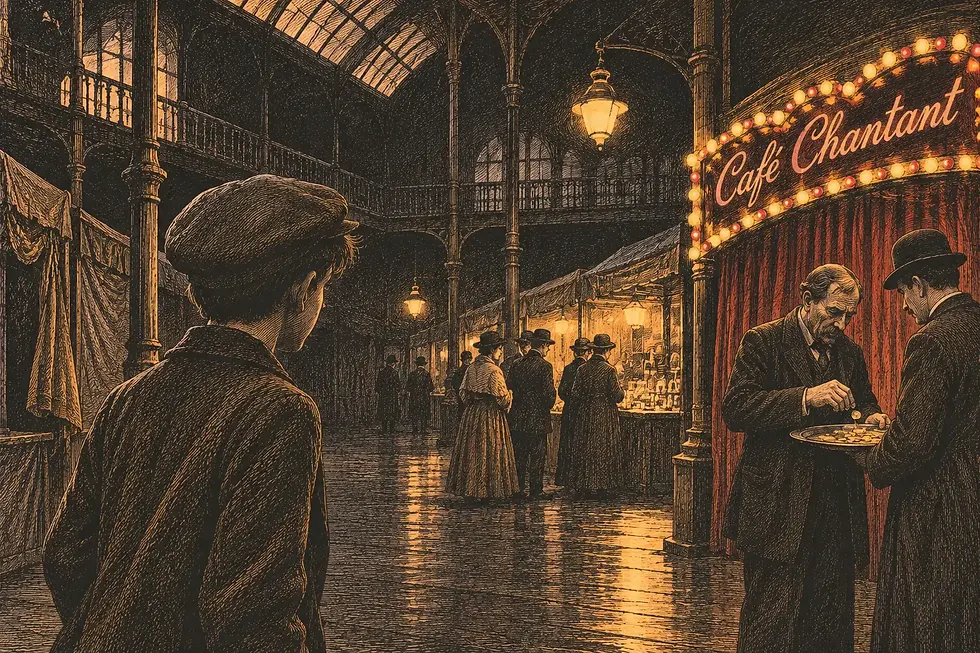
Remembering with difficulty why I had come, I went over to one of the stalls and examined porcelain vases and flowered tea-sets. At the door of the stall a young lady was talking and laughing with two young gentlemen. I remarked their English accents and listened vaguely to their conversation.
'O, I never said such a thing!'
'O, but you did!'
'O, but I didn't!'
'Didn't she say that?'
'Yes. I heard her.'
'O, there's a ... fib!'
Observing me, the young lady came over and asked me did I wish to buy anything. The tone of her voice was not encouraging; she seemed to have spoken to me out of a sense of duty. I looked humbly at the great jars that stood like eastern guards at either side of the dark entrance to the stall and murmured:
'No, thank you.'
The young lady changed the position of one of the vases and went back to the two young men. They began to talk of the same subject. Once or twice the young lady glanced at me over her shoulder.
I lingered before her stall, though I knew my stay was useless, to make my interest in her wares seem the more real. Then I turned away slowly and walked down the middle of the bazaar. I allowed the two pennies to fall against the sixpence in my pocket. I heard a voice call from one end of the gallery that the light was out. The upper part of the hall was now completely dark.
Gazing up into the darkness I saw myself as a creature driven and derided by vanity; and my eyes burned with anguish and anger.
Part I — Theme in James Joyce’s Araby
North Richmond Street, where James Joyce’s “Araby” begins, offers little suggestion of the extraordinary. The street is quiet, its houses face one another with “brown imperturbable faces,” and an uninhabited building stands at its blind end. Even the description of the houses suggests a settled existence governed by habit and convention. The narrator grows up in surroundings where the possibilities of daily life appear familiar and limited.
Against this background, his fascination with Mangan’s sister introduces an experience that seems to belong to another world. Each morning, he watches for her appearance from behind the parlour blind, then follows her towards school. Although he has scarcely spoken to her, her presence occupies his thoughts. The intensity of his attachment is striking because so little has occurred between them. His feelings develop largely through observation and imagination rather than personal acquaintance.
The narrator’s language reveals how thoroughly he has idealized the girl. He describes carrying the thought of her through the crowded streets as though he were protecting a sacred object. His reference to a “chalice” gives his devotion a religious character, transforming an ordinary adolescent attraction into something resembling worship. The image suggests sincerity, but it also exposes the disproportion between his limited knowledge of Mangan’s sister and the significance he assigns to her.
Joyce does not suggest that the boy’s feelings are insincere. Their intensity is part of the experience he portrays. The difficulty lies in the narrator’s tendency to confuse the importance of his emotions with the qualities of the person who inspires them. Mangan’s sister remains largely unknown to him, while his imagined understanding of her becomes increasingly elaborate. His romantic idealism depends upon this distance between the girl herself and the figure she has become in his imagination.
Araby and the Promise of Another World
The narrator’s expectations acquire a new direction when Mangan’s sister mentions the bazaar called Araby. She regrets that she cannot attend, and he promises to bring her something if he goes. The exchange is brief, yet it gives his devotion a purpose. He can now imagine performing an action that will express feelings he has been unable to communicate directly.
The name of the bazaar contributes to its attraction. To the boy, Araby suggests a distant place associated with unfamiliar sights and possibilities. Its appeal does not arise from any knowledge of the goods on sale or the people who will attend. The narrator responds instead to the associations the name awakens. He has already transformed Mangan’s sister through imagination; now he begins to transform the bazaar in much the same way.
As Saturday approaches, ordinary responsibilities become increasingly difficult to tolerate. The narrator finds his schoolwork tedious and resents the demands of daily life. His attention remains fixed upon the approaching journey, which seems to promise a fulfilment unavailable in his familiar surroundings. The anticipated visit begins to matter more than anything he actually knows about the event.
The bazaar thus becomes the imagined destination of his romantic aspirations. He expects the journey to give his devotion a visible form, perhaps through the purchase of a gift. Yet the importance of Araby rests upon expectations that the place itself has done nothing to establish. The boy has created an ideal experience before encountering the circumstances in which it must occur.
The Bazaar and the Collapse of Expectation
The evening of the journey introduces a series of frustrations. The narrator’s uncle returns home late, delaying his departure, and the boy must wait while the hours pass. When he finally leaves, his excitement has become entangled with impatience and anxiety. The ordinary arrangements upon which his adventure depends prove indifferent to the importance he attaches to it.
The contrast between imagination and experience becomes unmistakable when he reaches Araby. The building is largely deserted, most of the stalls have closed, and much of the hall is dark. The narrator had anticipated an extraordinary destination, but he encounters a commercial establishment approaching the end of its business day. The details are ordinary enough in themselves. Their significance emerges from their failure to correspond to the world he imagined.
Joyce gives particular attention to the sounds of the bazaar. Two men count money on a salver, and the narrator listens to the falling coins. The detail draws attention to the commercial activity underlying the event. Where the boy had imagined an opportunity for romantic devotion, he finds people occupied with transactions and practical concerns. The bazaar possesses a purpose independent of the meaning he has assigned to it.
His encounter with a young woman at one of the remaining stalls deepens his disappointment. She asks whether he wishes to buy anything, but her manner suggests little interest in his presence. Her conversation with two young men occupies her attention, and the narrator soon recognizes that he has no reason to remain. Nothing in the exchange corresponds to the significance he had attached to purchasing a gift.
The experience does not reveal that Araby is inherently disappointing. A visitor with different expectations might have found nothing remarkable about the closing stalls or the indifferent shop assistant. The narrator’s disappointment arises from the distance between the actual bazaar and the ideal he has constructed around it. The encounter exposes the limitations of his expectations rather than establishing a general judgment about the place.
The Theme of Disillusionment
At the conclusion of the story, the narrator stands in the darkened hall as the remaining lights are extinguished. The anticipated journey has ended without the gift he intended to purchase. More significantly, the experience has disturbed his understanding of the feelings that brought him there.
His final words reveal the severity of this recognition:
“Gazing up into the darkness I saw myself as a creature driven and derided by vanity; and my eyes burned with anguish and anger.”
The narrator now perceives something troubling in his earlier behaviour. His devotion, which had seemed noble and selfless, appears to him as an expression of vanity. The word suggests that his imagined importance as a romantic admirer may have mattered more than his actual relationship with Mangan’s sister. His anger is directed not simply at the disappointing bazaar but also at his own susceptibility to illusion.
This recognition brings the story’s central theme into focus. Disillusionment occurs when an experience challenges beliefs or expectations that previously appeared convincing. In “Araby,” the narrator’s disappointment is inseparable from the idealized vision through which he has understood his feelings. The bazaar does not merely fail to satisfy his hopes; it exposes the assumptions upon which those hopes depended.
The narrator’s final judgment nevertheless requires some qualification. His description of himself as a creature driven by vanity is severe, particularly when considered against his youth and inexperience. His romantic idealism may have been exaggerated, but his feelings were not necessarily false. Joyce allows readers to recognize both the limitations of the boy’s earlier expectations and the emotional intensity of his response to their collapse.
The ending therefore presents self-knowledge as an incomplete and potentially painful achievement. The narrator recognizes something about his own desires, but the story does not establish that he has acquired a mature understanding of love or human relationships. His movement from idealization to self-condemnation may itself reveal the difficulty of interpreting experience without exaggeration.
How the Theme Develops Through the Story
The meaning of “Araby” depends upon the gradual relationship between the narrator’s expectations and the circumstances that challenge them. Joyce does not begin by announcing a general proposition about romantic illusion. He presents a boy whose feelings transform familiar surroundings, follows the growth of his anticipation, and allows an ordinary encounter to expose the limits of his imagined world.
The story’s imagery contributes to this progression. Light initially accompanies the narrator’s idealized perception of Mangan’s sister. He observes her figure illuminated against the surrounding darkness, and the contrast helps distinguish her from the ordinary world. At the bazaar, the extinguishing lights accompany the disappearance of his expectations. The imagery acquires its significance through the changing circumstances in which it appears.
The narrative structure produces a related effect. Joyce devotes considerable attention to the narrator’s anticipation, while the actual visit occupies a relatively brief portion of the story. Readers spend more time within the boy’s imagined experience than at the destination itself. This imbalance reflects the importance of expectation in his emotional life and makes the contrast with reality more pronounced.
These details contribute to a larger pattern. The narrator repeatedly invests people and places with meanings derived from his desires, only to discover that the external world does not necessarily sustain them. His experience suggests that imagination can enrich ordinary life while also creating expectations that reality cannot fulfil.
The theme of disillusionment emerges from this pattern rather than from any single incident. Mangan’s sister, the anticipated journey, the closing bazaar, and the narrator’s final recognition all contribute to its development. Each element acquires greater significance through its relationship with the others.
Joyce’s story illustrates how a literary theme differs from a subject or an isolated event. Romantic attraction is one of the story’s subjects, and the disappointing visit to Araby is an important event. The theme develops through what these experiences reveal about the relationship between desire, imagination, and self-knowledge. It is this underlying meaning, established through the narrative as a whole, that gives the boy’s brief experience its lasting significance.
Part II — Understanding Theme in Fiction
From Story to Meaning
At the end of James Joyce’s “Araby,” a young boy stands in a darkened bazaar, overcome by anger and disappointment. His journey has failed to fulfil the expectations he attached to it. Yet the significance of the ending extends beyond the unsuccessful visit. The boy has begun to recognize something about the romantic hopes that brought him there.
The difference between these two levels of understanding is central to reading fiction. A narrative presents characters, actions, and circumstances, but the relationships among these elements may suggest ideas that reach beyond the particular events. In “Araby,” the narrator’s disappointment becomes meaningful because readers have witnessed the growth of his expectations. The ending invites them to reconsider his earlier behaviour and the assumptions that shaped it.
The larger idea developed through such relationships is called a theme. A theme concerns an aspect of human experience that a literary work explores through its narrative. It may involve love, ambition, identity, freedom, responsibility, or any number of other concerns. Its meaning emerges from the particular treatment these subjects receive within the work.
A theme is therefore neither a summary of events nor a statement that can be separated entirely from the story. The theme of disillusionment in “Araby” depends upon the narrator’s romantic idealism, his anticipation of the bazaar, and his final recognition. Without these experiences, the general idea would lose much of its literary significance.
Subject, Theme, and Thematic Statement
Literary discussions sometimes use the words subject and theme interchangeably, but the distinction between them helps clarify what an interpretation must explain.
A subject identifies an area of experience represented in a work. Love, jealousy, ambition, and isolation are subjects because they name concerns that a story may examine. They do not, by themselves, indicate what the writer develops or reveals about those concerns.
Consider Guy de Maupassant’s “The Necklace.” One of its subjects is social ambition. Mathilde Loisel longs for a more luxurious life and feels dissatisfied with her circumstances. Her desire for wealth and status influences her decisions and contributes to the consequences that follow.
The story develops a more particular idea through Mathilde’s experience. Her concern with social appearances leads her to borrow a necklace, and the loss of that necklace results in years of hardship. The eventual discovery that the jewels were imitation complicates the relationship between appearance and value. A thematic interpretation might suggest that the pursuit of social status can lead individuals to sacrifice what they already possess.
This interpretation is more specific than the subject of ambition. It explains a relationship between desire, behaviour, and consequence that the narrative develops.
A thematic statement expresses such an interpretation in a complete sentence. It identifies an idea about human experience and indicates what the literary work suggests about it. A useful thematic statement is broad enough to extend beyond the particular characters but precise enough to remain supported by the text.
The distinction can be illustrated through “Araby.”
Subject: Romantic idealism.
Theme: The relationship between romantic idealism and disillusionment.
Thematic statement: Romantic idealization can create expectations that ordinary experience cannot fulfil.
The first identifies a concern. The second describes the idea being explored. The third expresses an interpretation of what the story suggests about that idea.
A thematic statement should not claim more than the narrative supports. “Romantic love always leads to disappointment,” for example, would turn the narrator’s particular experience into an absolute judgment. Joyce examines the consequences of one boy’s idealized expectations, not the inevitable outcome of every romantic attachment.
How a Theme Develops
A literary theme becomes recognizable through the relationships among events and details. A single incident may suggest an idea, but its significance often depends upon what has occurred earlier and what follows.
In O. Henry’s “The Gift of the Magi,” a young married couple each sacrifices a treasured possession to purchase a Christmas gift for the other. Della sells her hair to buy Jim a watch chain, while Jim sells his watch to buy Della a set of combs. The gifts become practically useless, yet the sacrifices reveal the depth of their mutual affection.
The ending changes how readers understand the apparent failure of the exchange. Judged by practical usefulness, the gifts accomplish little. Judged by the generosity they express, they acquire considerable value. The story develops a theme concerning the relationship between love, sacrifice, and material possessions.
This meaning depends upon several connected elements. The couple’s poverty establishes the difficulty of giving. Their separate decisions demonstrate their willingness to sacrifice. The exchange of gifts reveals the irony of their actions. Each element contributes to the significance of the others.
Themes often develop in this manner. A character’s decisions, the conflicts those decisions create, and their eventual consequences establish relationships through which a larger idea becomes visible.
Other literary elements may contribute to the same development. Setting can place characters within particular social conditions. Imagery can establish associations that acquire significance through repetition. Narrative perspective can influence what readers understand about a character’s motives or judgments.
No single element necessarily determines the theme. Its importance depends upon how it functions within the work as a whole.
Recognizing Patterns and Contrasts
Readers often begin to recognize a theme when they notice that different parts of a story develop a similar concern.
In Charlotte Perkins Gilman’s “The Yellow Wallpaper,” the narrator repeatedly encounters restrictions imposed upon her behaviour. Her husband dismisses her concerns, discourages intellectual activity, and controls important aspects of her daily life. As her isolation increases, she becomes increasingly absorbed in the wallpaper of the room where she spends much of her time.
These details establish a pattern of confinement. The narrator’s physical surroundings reflect the restrictions placed upon her independence, while her growing preoccupation with the wallpaper gives those restrictions a disturbing psychological dimension.
The story’s treatment of confinement supports a broader interpretation concerning the consequences of denying individuals authority over their own lives. The theme emerges not from the wallpaper alone but from its relationship with the narrator’s circumstances, her husband’s behaviour, and her changing state of mind.
Contrasts can be equally important.
In “The Gift of the Magi,” the practical uselessness of the exchanged gifts contrasts with their emotional significance. In “Araby,” the narrator’s imagined bazaar contrasts with the commercial establishment he eventually encounters. These differences encourage readers to examine the assumptions through which characters assign value to their experiences.
A repeated detail does not automatically establish a theme. Its importance must be considered in relation to the story’s development. An object may contribute to atmosphere in one passage and acquire thematic significance only when later events change how readers understand it.
The task is to recognize meaningful relationships rather than assign an abstract idea to every detail.
Theme Is Not the Same as a Moral
Some stories communicate lessons about conduct. Fables, for example, frequently organize their events around a moral that can be expressed as a direct statement.
In Aesop’s “The Tortoise and the Hare,” the hare’s confidence and carelessness allow the slower tortoise to win the race. The familiar moral encourages persistence and warns against complacency. The narrative is constructed to illustrate this practical lesson.
Literary fiction often develops meaning less directly.
In Kate Chopin’s “The Story of an Hour,” Louise Mallard learns that her husband has reportedly died. Although she initially experiences grief, she gradually recognizes the possibility of a life in which she might exercise greater independence. The unexpected return of her husband brings this imagined freedom to an abrupt end.
The story explores marriage, autonomy, and the tension between social expectations and personal desire. Reducing its meaning to the advice that individuals should seek independence would overlook the conflicting emotions and social circumstances through which Chopin develops these concerns.
A moral generally recommends or condemns a particular form of behaviour. A theme may instead examine a condition, expose a contradiction, or explore an unresolved problem.
This distinction does not mean that themes lack ethical significance. A story may encourage readers to reconsider their assumptions about justice, responsibility, or human relationships without issuing an explicit instruction.
In “Araby,” the narrator’s disappointment invites reflection upon romantic idealization, but Joyce does not provide a rule for avoiding such experiences. The story remains concerned with the complexity of the boy’s developing awareness.
Can a Story Have More Than One Theme?
A literary work may develop several themes because its characters and conflicts involve more than one aspect of human experience.
Consider Nathaniel Hawthorne’s “Young Goodman Brown.” The protagonist’s journey into the forest challenges his confidence in the moral character of the people around him. His experience raises questions about religious faith, the presence of evil, and the difficulty of distinguishing appearance from reality.
These concerns are closely related, but they are not identical. An analysis of faith might examine Brown’s changing beliefs about his community. An analysis of appearance and reality might focus on the uncertainty surrounding what he witnesses in the forest. Both interpretations would draw upon the same narrative while emphasizing different relationships among its details.
The presence of several themes does not mean that every possible interpretation carries equal weight. A convincing analysis must account for the evidence and the work’s larger structure.
The same principle applies to “Araby.” The story explores romantic idealism, disillusionment, and the beginnings of self-knowledge. These concerns develop through the narrator’s changing expectations, and each helps illuminate the others.
When examining one theme, readers should identify the pattern most relevant to their interpretation. Related themes can deepen the discussion without replacing its central argument.
Developing a Thematic Interpretation
Identifying a theme provides a starting point for literary analysis. The next task is to explain how the work develops that idea.
Consider again the narrator’s disappointment in “Araby.” The ending suggests disillusionment, but naming the theme does not explain why the experience affects him so profoundly.
The analysis must return to the earlier narrative. The boy’s limited acquaintance with Mangan’s sister contrasts with the intensity of his devotion. His religious language reveals the extraordinary importance he assigns to her. His anticipation of the bazaar extends this idealization to a place he has never visited.
These details establish the expectations that the final experience challenges.
A thematic interpretation might therefore argue that Joyce presents disillusionment as the painful recognition that personal desire can distort the way individuals understand the world.
The argument becomes convincing when the analysis connects specific textual evidence to this larger idea.
For example, the narrator’s reference to carrying a “chalice” through the crowded streets suggests that he understands his romantic feelings through the language of religious devotion. The image elevates his attachment beyond an ordinary attraction, even though his relationship with Mangan’s sister remains limited.
The significance of the image becomes clearer when considered alongside the closing bazaar. The boy arrives expecting an experience worthy of his devotion, but encounters indifferent people and ordinary commercial activity. The contrast reveals how little his imagined understanding corresponds to the circumstances before him.
A developed analysis explains these relationships rather than simply collecting examples.
It must also remain attentive to uncertainty. The narrator’s final judgment of himself may reveal genuine insight, but its severity complicates the idea that he has achieved complete self-knowledge. Recognizing this limitation makes the interpretation more faithful to the story.
Writing a Thematic Analysis
A thematic paragraph usually begins with a claim about how a particular detail or development contributes to the story’s meaning. The claim should be interpretive rather than descriptive.
For example, a sentence stating that the narrator visits the bazaar describes an event. A sentence explaining that the bazaar exposes the limitations of his romantic expectations begins to interpret that event.
The interpretation then requires evidence. A writer might refer to the closing stalls, the darkened hall, or the indifferent response of the young woman attending one of the stalls.
The next step is to explain how the evidence supports the claim. The ordinary atmosphere of the bazaar matters because the narrator has invested the destination with extraordinary personal significance. The contrast between expectation and experience contributes to his final recognition.
A paragraph should develop this reasoning rather than move immediately to another example. The purpose of textual evidence is not merely to demonstrate familiarity with the story but to make an interpretation understandable and persuasive.
The strongest analyses also distinguish between what the text explicitly presents and what readers infer from it. Joyce describes the narrator’s behaviour and final emotional response. The conclusion that romantic idealization has shaped his perception emerges from examining the relationships among those details.
Such distinctions allow literary interpretation to remain thoughtful without becoming speculative.
Understanding Theme Through Close Reading
Theme is sometimes treated as a message that readers must discover after finishing a story. This approach can encourage interpretations that are too general or insufficiently connected to the text.
A more productive understanding begins with close reading. Readers observe what characters desire, how they respond to difficulties, which details recur, and how the significance of earlier events changes as the narrative develops.
In “Araby,” the narrator’s final recognition cannot be understood independently of his earlier expectations. The closing bazaar acquires its significance because readers have followed the imaginative importance he assigned to it. His disappointment reveals something about the relationship between desire and perception that the story has been developing from its opening pages.
Theme is therefore not an idea added to the narrative after its events have been understood. It emerges through the relationships that give those events significance.
To analyze a theme is to explain those relationships: how particular experiences develop a larger idea, how literary elements contribute to its meaning, and where the work complicates an interpretation that might otherwise seem straightforward.
The result is not simply a statement about what a story means. It is an account of how the story creates that meaning.
✧ ✦ ✧ ✦ ✧ ✦ ✧


Comments