Ring Lardner’s Haircut: A Guide to Point of View

Updated: Aug 6
At first, Haircut hardly seems to be a formal narrative. A barber cuts a customer’s hair and fills the time with stories about the people of his town. One memory leads to another, and the talk moves with the looseness of ordinary gossip. Yet the apparent ease of the conversation depends upon careful selection. The story is shaped by what the barber remembers, the order in which he remembers it, and the significance he fails to recognise.
Lardner therefore does not present events directly. He gives them to us through the barber’s voice. We learn what the barber has seen and heard, but we also encounter his judgments, assumptions, and omissions. Nothing in the story stands outside that perspective to correct him. The narrator does more than report the town’s history; he becomes the medium through which that history must be understood.
This distinction matters because the barber’s account cannot always be accepted at face value. Notice which details he treats as amusing, which incidents he dismisses, and which consequences scarcely trouble him. His manner of telling often reveals more than his explicit opinions. As the anecdotes accumulate, the reader begins to separate the meaning the barber assigns to events from the meaning those events acquire in the story.
A narrator always shapes the reader’s access to a fictional world. In Haircut, that shaping power belongs to a man who appears ordinary, sociable, and confident in his own understanding. The story’s effect depends upon the widening distance between his judgment and ours.
▶ Meet the Author
Ring Lardner (1885–1933)

❦ Five Things to Know
✠ Born Ringgold Wilmer Lardner in Niles, Michigan, in 1885.
✠ Began his career as a newspaper reporter and became one of America’s most celebrated sports journalists, later achieving equal distinction as a short-story writer.
✠ Wrote short stories, novels, plays, and magazine pieces, drawing his material from everyday American life, sport, and popular culture.
✠ Was admired by writers such as F. Scott Fitzgerald, Ernest Hemingway, and Virginia Woolf for his originality and mastery of dialogue.
✠ Remembered as one of the finest American short-story writers of the twentieth century, celebrated for his humour, irony, and remarkably authentic rendering of American speech.
❦ His Writing Style
Ring Lardner transformed everyday conversation into literature. His stories are distinguished by natural dialogue, subtle irony, and an extraordinary ability to reveal character through the way people speak rather than through authorial explanation. Beneath the humour lies a keen understanding of vanity, self-deception, and the quiet tragedies of ordinary life. Rather than judging his characters directly, Lardner trusts readers to discover the truth for themselves.
⁂ More Stories by Ring Lardner
Some Like Them Cold
Champion
Alibi Ike
❝ Memorable Quote
“Shut up,” he explained.
Haircut
By Ring Lardner
I got another barber that comes over from Carterville and helps me out Saturdays, but the rest of the time I can get along all right alone. You can see for yourself that this ain't no New York City and besides that, the most of the boys works all day and don't have no leisure to drop in here and get themselves prettied up.
You're a newcomer, ain't you? I thought I hadn't seen you round before. I hope you like it good enough to stay. As I say, we ain't no New York City or Chicago, but we have pretty good times. Not as good, though, since Jim Kendall got killed. When he was alive, him and Hod Meyers used to keep this town in an uproar. I bet they was more laughin' done here than any town its size in America.
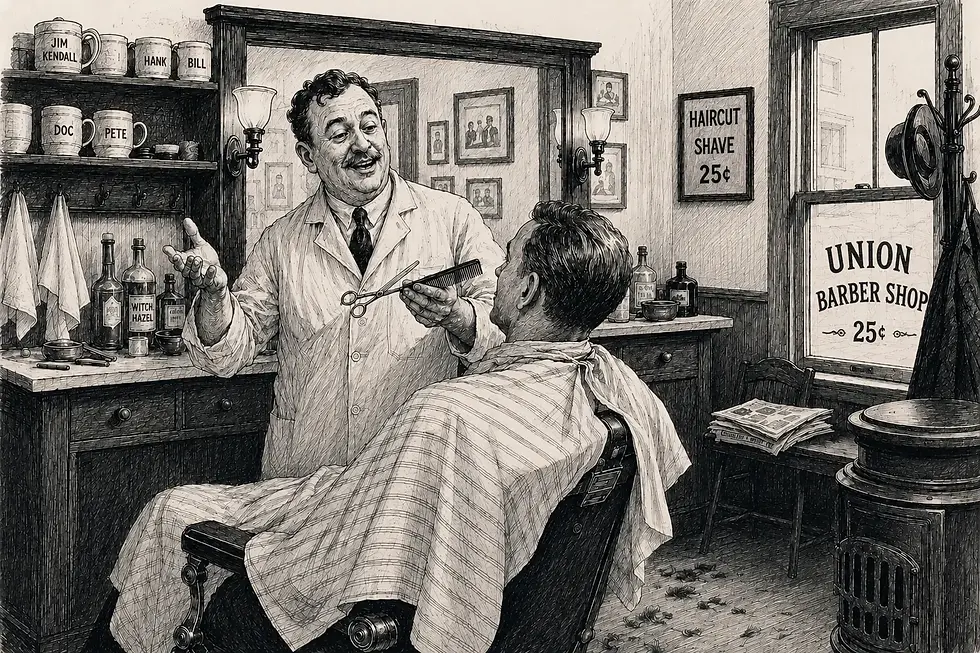
Jim was comical, and Hod was pretty near a match for him. Since Jim's gone, Hod tries to hold his end up just the same as ever, but it's tough goin' when you ain't got nobody to kind of work with.
They used to be plenty fun in here Saturdays. This place is jampacked Saturdays, from four o'clock on. Jim and Hod would show up right after their supper round six o'clock. Jim would set himself down in that big chair, nearest the blue spittoon. Whoever had been settin' in that chair, why they'd get up when Jim come in and at" it to him.
You'd of thought it was a reserved seat like they have sometimes in a theaytre. Hod would generally always stand or walk up and down or some Saturdays, of course, he'd be settin' in this chair part of the time, gettin' a haircut.
Well, Jim would set there a w'ile without opening his mouth only to spit, and then finally he'd say to me, "Whitey,"--my right name, that is, my right first name, is Dick, but everybody round here calls me Whitey--Jim would say, "Whitey, your nose looks like a rosebud tonight. You must of been drinkin' some of your aw de cologne."
So I'd say, "No, Jim, but you look like you'd been drinkin' something of that kind or somethin' worse."
Jim would have to laugh at that, but then he'd speak up and say, "No, I ain't had nothin' to drink, but that ain't sayin' I wouldn't like somethin'. I wouldn't even mind if it was wood alcohol."
Then Hod Meyers would say, "Neither would your wife." That would set everybody to laughin' because Jim and his wife wasn't on very good terms. She'd of divorced him only they wasn't no chance to get alimony and she didn't have no way to take care of herself and the kids. She couldn't never understand Jim. He was kind of rough, but a good fella at heart.
Him and Hod had all kinds of sport with Milt Sheppard. I don't suppose you've seen Milt. Well, he's got an Adam's apple that looks more like a mush-melon. So I'd be shavin' Milt and when I'd start to shave down here on his neck, Hod would holler, "Hey, Whitey, wait a minute! Before you cut into it, let's make up a pool and see who can guess closest to the number of seeds."
And Jim would say, "If Milt hadn't of been so hoggish, he'd of ordered a half a cantaloupe instead of a whole one and it might not of stuck in his throat."
All the boys would roar at this and Milt himself would force a smile, though the joke was on him. Jim certainly was a card!
There's his shavin' mug, setting on the shelf, right next to Charley Vail's. "Charles M. Vail." That's the druggist. He comes in regular for his shave, three times a week. And Jim's is the cup next to Charley's. "dames H. Kendall." Jim won't need no shavin' mug no more, but I'll leave it there just the same for old time's sake. Jim certainly was a character!
Years ago, Jim used to travel for a canned goods concern over in Carterville. They sold canned goods. Jim had the whole northern half of the State and was on the road five days out of every week. He'd drop in here Saturdays and tell his experiences for that week. It was rich.
I guess he paid more attention to playin' jokes than makin' sales. Finally the concern let him out and he come right home here and told everybody he'd been fired instead of sayin' he'd resigned like most fellas would of.
It was a Saturday and the shop was full and Jim got up out of that chair and says, "Gentlemen, I got an important announcement to make. I been fired from my job."
Well, they asked him if he was in earnest and he said he was and nobody could think of nothin' to say till Jim finally broke the ice himself. He says, "I been sellin' canned goods and now I'm canned goods myself."
You see, the concern he'd been workin' for was a factory that made canned goods. Over in Carterville. And now Jim said he was canned himself. He was certainly a card!
Jim had a great trick that he used to play w'ile he was travelin'. For instance, he'd be ridin' on a train and they'd come to some little town like, well, like, well, like, we'll say, like Benton. Jim would look out the train window and read the signs of the stores.
For instance, they'd be a sign, "Henry Smith, Dry Goods." Well, Jim would write down the name and the name of the town and when he got to wherever he was goin' he'd mail back a postal card to Henry Smith at Benton and not sign no name to it, but he'd write on the card, well somethin' like "Ask your wife about that book agent that spent the afternoon last week," or "Ask your Missus who kept her from gettin' lonesome the last time you was in Carterville." And he'd sign the card, "A Friend."
Of course, he never knew what really come of none of these jokes, but he could picture what probably happened and that was enough.
Jim didn't work very steady after he lost his position with the Carterville people. What he did earn, coin' odd jobs round town why he spent pretty near all of it on gin, and his family might of starved if the stores hadn't of carried them along. Jim's wife tried her hand at dressmakin', but they ain't nobody goin' to get rich makin' dresses in this town.
As I say, she'd of divorced Jim, only she seen that she couldn't support herself and the kids and she was always hopin' that some day Jim would cut out his habits and give her more than two or three dollars a week.

They was a time when she would go to whoever he was workin' for and ask them to give her his wages, but after she done this once or twice, he beat her to it by borrowin' most of his pay in advance. He told it all round town, how he had outfoxed his Missus. He certainly was a caution!
But he wasn't satisfied with just outwittin' her. He was sore the way she had acted, tryin' to grab off his pay. And he made up his mind he'd get even. Well, he waited till Evans's Circus was advertised to come to town. Then he told his wife and two kiddies that he was goin' to take them to the circus. The day of the circus, he told them he would get the tickets and meet them outside the entrance to the tent.
Well, he didn't have no intentions of bein' there or buyin' tickets or nothin'. He got full of gin and laid round Wright's poolroom all day. His wife and the kids waited and waited and of course he didn't show up. His wife didn't have a dime with her, or nowhere else, I guess. So she finally had to tell the kids it was all off and they cried like they wasn't never goin' to stop.
Well, it seems, w'ile they was cryin', Doc Stair come along and he asked what was the matter, but Mrs. Kendall was stubborn and wouldn't tell him, but the kids told him and he insisted on takin' them and their mother in the show. Jim found this out afterwards and it was one reason why he had it in for Doc Stair.
Doc Stair come here about a year and a half ago. He's a mighty handsome young fella and his clothes always look like he has them made to order. He goes to Detroit two or three times a year and w'ile he's there must have a tailor take his measure and then make him a suit to order. They cost pretty near twice as much, but they fit a whole lot better than if you just bought them in a store.
For a w'ile everybody was wonderin' why a young doctor like Doc Stair should come to a town like this where we already got old Doc Gamble and Doc Foote that's both been here for years and all the practice in town was always divided between the two of them.
Then they was a story got round that Doc Stair's gal had thronged him over, a gal up in the Northern Peninsula somewhere, and the reason he come here was to hide himself away and forget it. He said himself that he thought they wasn't nothin' like general practice in a place like ours to fit a man to be a good all round doctor. And that's why he'd came.
Anyways, it wasn't long before he was makin' enough to live on, though they tell me that he never dunned nobody for what they owed him, and the folks here certainly has got the owin' habit, even in my business. If I had all that was comin' to me for just shaves alone, I could go to Carterville and put up at the Mercer for a week and see a different picture every night. For instance, they's old George Purdy--but I guess I shouldn't ought to be gossipin'.
Well, last year, our coroner died, died of the flu. Ken Beatty, that was his name. He was the coroner. So they had to choose another man to be coroner in his place and they picked Doc Stair. He laughed at first and said he didn't want it, but they made him take it. It ain't no job that anybody would fight for and what a man makes out of it in a year would just about buy seeds for their garden. Doc's the kind, though, that can't say no to nothin' if you keep at him long enough.
But I was goin' to tell you about a poor boy we got here in town-Paul Dickson. He fell out of a tree when he was about ten years old. Lit on his head and it done somethin' to him and he ain't never been right. No harm in him, but just silly. Jim Kendall used to call him cuckoo; that's a name Jim had for anybody that was off their head, only he called people's head their bean. That was another of his gags, callin' head bean and callin' crazy people cuckoo. Only poor Paul ain't crazy, but just silly.
You can imagine that Jim used to have all kinds of fun with Paul. He'd send him to the White Front Garage for a left-handed monkey wrench. Of course they ain't no such thing as a left-handed monkey wrench.
And once we had a kind of a fair here and they was a baseball game between the fats and the leans and before the game started Jim called Paul over and sent him way down to Schrader's hardware store to get a key for the pitcher's box.
They wasn't nothin' in the way of gags that Jim couldn't think up, when he put his mind to it.
Poor Paul was always kind of suspicious of people, maybe on account of how Jim had kept foolin' him. Paul wouldn't have much to do with anybody only his own mother and Doc Stair and a girl here in town named Julie Gregg. That is, she ain't a girl no more, but pretty near thirty or over.
When Doc first come to town, Paul seemed to feel like here was a real friend and he hung round Doc's office most of the w'ile; the only time he wasn't there was when he'd go home to eat or sleep or when he seen Julie Gregg coin' her shoppin'.
When he looked out Doc's window and seen her, he'd run downstairs and join her and tag along with her to the different stores. The poor boy was crazy about Julie and she always treated him mighty nice and made him feel like he was welcome, though of course it wasn't nothin' but pity on her side.
Doc done all he could to improve Paul's mind and he told me once that he really thought the boy was getting better, that they was times when he was as bright and sensible as anybody else.
But I was goin' to tell you about Julie Gregg. Old man Gregg was in the lumber business, but got to drinkin' and lost the most of his money and when he died, he didn't leave nothin' but the house and just enough insurance for the girl to skimp along on.
Her mother was a kind of a half invalid and didn't hardly ever leave the house. Julie wanted to sell the place and move somewhere else after the old man died, but the mother said she was born here and would die here. It was tough on Julie as the young people round this town--well, she's too good for them.
She'd been away to school and Chicago and New York and different places and they ain't no subject she can't talk on, where you take the rest of the young folks here and you mention anything to them outside of Gloria Swanson or Tommy Meighan and they think you're delirious. Did you see Gloria in Wages of Virtue? You missed somethin'!
Well, Doc Stair hadn't been here more than a week when he came in one day to get shaved and I recognized who he was, as he had been pointed out to me, so I told him about my old lady. She's been ailin' for a couple years and either Doc Gamble or Doc Foote, neither one, seemed to be helpin' her. So he said he would come out and see her, but if she was able to get out herself, it would be better to bring her to his office where he could make a completer examination.
So I took her to his office and w'ile I was waitin' for her in the reception room, in come Julie Gregg. When somebody comes in Doc Stair's office, they's a bell that rings in his inside office so he can tell they's somebody to see him.
So he left my old lady inside and come out to the front office and that's the first time him and Julie met and I guess it was what they call love at first sight. But it wasn't fifty-fifty. This young fella was the slickest lookin' fella she'd ever seen in this town and she went wild over him. To him she was just a young lady that wanted to see the doctor.
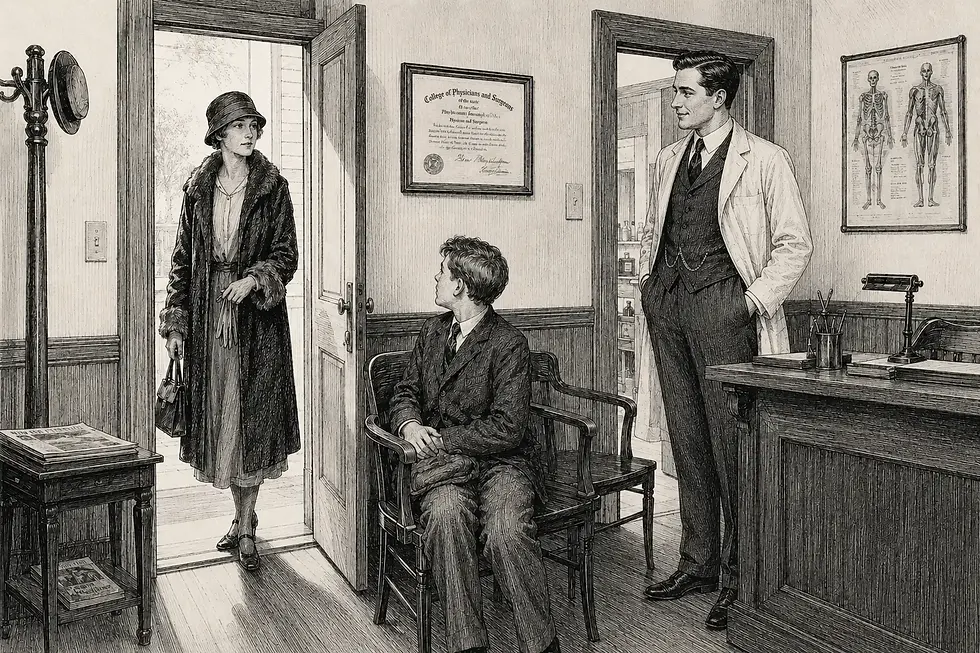
She'd came on about the same business I had. Her mother had been doctorin' for years with Doc Gamble and Doc Foote and without no results. So she'd heard they was a new doc in town and decided to give him a try. He promised to call and see her mother that same day.
I said a minute ago that it was love at first sight on her part. I'm not only judgin' by how she acted afterwards but how she looked at him that first day in his office. I ain't no mind reader, but it was wrote all over her face that she was gone.
Now Jim Kendall, besides bein' a jokesmith and a pretty good drinker, well Jim was quite a lady-killer. I guess he run pretty wild durin' the time he was on the road for them Carterville people, and besides that, he'd had a couple little affairs of the heart right here in town. As I say, his wife would have divorced him, only she couldn't.
But Jim was like the majority of men, and women, too, I guess. He wanted what he couldn't get. He wanted Julie Gregg and worked his head off tryin' to land her. Only he'd of said bean instead of head.
Well, Jim's habits and his jokes didn't appeal to Julie and of course he was a married man, so he didn't have no more chance than, well, than a rabbit. That's an expression of Jim's himself. When somebody didn't have no chance to get elected or somethin', Jim would always say they didn't have no more chance than a rabbit.
He didn't make no bones about how he felt. Right in here, more than once, in front of the whole crowd, he said he was stuck on Julie and anybody that could get her for him was welcome to his house and his wife and kids included. But she wouldn't have nothin' to do with him; wouldn't even speak to him on the street. He finally seen he wasn't gettin' nowheres with his usual line so he decided to try the rough stuff. He went right up to her house one evenin' and when she opened the door he forced his way in and grabbed her. But she broke loose and before he could stop her, she run in the next room and locked the door and phoned to Joe Barnes. Joe's the marshal. Jim could hear who she was phonin' to and he beat it before Joe got there.
Joe was an old friend of Julie's pa. Joe went to Jim the next day and told him what would happen if he ever done it again.
I don't know how the news of this little affair leaked out. Chances is that Joe Barnes told his wife and she told somebody else's wife and they told their husband. Anyways, it did leak out and Hod Meyers had the nerve to kid Jim about it, right here in this shop. Jim didn't deny nothin' and kind of laughed it off and said for us all to wait; that lots of people had tried to make a monkey out of him, but he always got even.
Meanw'ile everybody in town was wise to Julie's bein' wild mad over the Doc. I don't suppose she had any idea how her face changed when him and her was together; of course she couldn't of, or she'd of kept away from him. And she didn't know that we was all noticin' how many times she made excuses to go up to his office or pass it on the other side of the street and look up in his window to see if he was there. I felt sorry for her and so did most other people.
Hod Meyers kept rubbin' it into Jim about how the Doc had cut him out. Jim didn't pay no attention to the kiddie' and you could see he was plannin' one of his jokes.
One trick Jim had was the knack of changin' his voice. He could make you think he was a girl talkie' and he could mimic any man's voice. To show you how good he was along this line, I'll tell you the joke he played on me once.
You know, in most towns of any size, when a man is dead and needs a shave, why the barber that shaves him soaks him five dollars for the job; that is, he don't soak him, but whoever ordered the shave. I just charge three dollars because personally I don't mind much shavin' a dead person. They lay a whole lot stiller than live customers. The only thing is that you don't feel like talkie' to them and you get kind of lonesome.
Well, about the coldest day we ever had here, two years ago last winter, the phone rung at the house w'ile I was home to dinner and I answered the phone and it was a woman's voice and she said she was Mrs. John Scott and her husband was dead and would I come out and shave him.
Old John had always been a good customer of mine. But they live seven miles out in the country, on the Streeter road. Still I didn't see how I could say no.
So I said I would be there, but would have to come in a jitney and it might cost three or four dollars besides the price of the shave. So she, or the voice, it said that was all right, so I got Frank Abbott to drive me out to the place and when I got there, who should open the door but old John himself! He wasn't no more dead than, well, than a rabbit.
It didn't take no private detective to figure out who had played me this little joke. Nobody could of thought it up but Jim Kendall. He certainly was a card!
I tell you this incident just to show you how he could disguise his voice and make you believe it was somebody else talkie'. I'd of swore it was Mrs. Scott had called me. Anyways, some woman.
Well, Jim waited till he had Doc Stair's voice down pat; then he went after revenge.
He called Julie up on a night when he knew Doc was over in Carterville. She never questioned but what it was Doc's voice. Jim said he must see her that night; he couldn't wait no longer to tell her somethin'. She was all excited and told him to come to the house. But he said he was expectin' an important long distance call and wouldn't she please forget her manners for once and come to his office. He said they couldn't nothin' hurt her and nobody would see her and he just must talk to her a little w'ile. Well, poor Julie fell for it.
Doc always keeps a night light in his office, so it looked to Julie like they was somebody there.
Meanw'ile Jim Kendall had went to Wright's poolroom, where they was a whole gang amusin' themselves. The most of them had drank plenty of gin, and there was a rough bunch even when sober. They was always strong for Jim's jokes and when he told them to come with him and see some fun they give up their card games and pool games and followed along.
Doc's office is on the second floor. Right outside his door they's a flight of stairs leadin' to the floor above. Jim and his gang hid in the dark behind these stairs.
Well, tulle come up to Doc's door and rung the bell and they was nothin' coin'. She rung it again and she rung it seven or eight times. Then she tried the door and found it locked. Then Jim made some kind of a noise and she heard it and waited a minute, and then she says, "Is that you, Ralph?" Ralph is Doc's first name.

They was no answer and it must of came to her all of a sudden that she'd been bunked. She pretty near fell downstairs and the whole gang after her. They chased her all the way home, hollerin', "Is that you, Ralph?" and "Oh, Ralphie, dear, is that you?" Jim says he couldn't holler it himself, as he was laughin' too hard.
Poor Julie! She didn't show up here on Main Street for a long, long time afterward.
And of course Jim and his gang told everybody in town, everybody but Doc Stair. They was scared to tell him, and he might of never knowed only for Paul Dickson. The poor cuckoo, as Jim called him, he was here in the shop one night when Jim was still gloatin' yet over what he'd done to Julie. And Paul took in as much of it as he could understand and he run to Doc with the story.
It's a cinch Doc went up in the air and swore he'd make Jim suffer. But it was a kind of a delicate thing, because if it got out that he had beat Jim up, Julie was bound to hear of it and then she'd know that Doc knew and of course knowin' that he knew would make it worse for her than ever. He was goin' to do somethin', but it took a lot of figurin'.
Well, it was a couple days later when Jim was here in the shop again, and so was the cuckoo. Jim was goin' duck-shootin' the next day and had come in lookin' for Hod Meyers to go with him. I happened to know that Hod had went over to Carterville and wouldn't be home till the end of the week. So Jim said he hated to go alone and he guessed he would call it off. Then poor Paul spoke up and said if Jim would take him he would go along. Jim thought a w'ile and then he said, well, he guessed a half-wit was better than nothin'.
I suppose he was plottin' to get Paul out in the boat and play some joke on him, like pushin' him in the water. Anyways, he said Paul could go. He asked him had he ever shot a duck and Paul said no, he'd never even had a gun in his hands. So Jim said he could set in the boat and watch him and if he behaved himself, he might lend him his gun for a couple of shots. They made a date to meet in the mornin' and that's the last I seen of Jim alive.
Next mornin', I hadn't been open more than ten minutes when Doc Stair come in. He looked kind of nervous. He asked me had I seen Paul Dickson. I said no, but I knew where he was, out duckshootin' with Jim Kendall. So Doc says that's what he had heard, and he couldn't understand it because Paul had told him he wouldn't never have no more to do with Jim as long as he lived.
He said Paul had told him about the joke Jim had played on Julie. He said Paul had asked him what he thought of the joke and the Doc told him that anybody that would do a thing like that ought not to be let live. I said it had been a kind of a raw thing, but Jim just couldn't resist no kind of a joke, no matter how raw. I said I thought he was all right at heart, but just bubblin' over with mischief. Doc turned and walked out.
At noon he got a phone call from old John Scott. The lake where Jim and Paul had went shootin' is on John's place. Paul had came runnin' up to the house a few minutes before and said they'd been an accident. Jim had shot a few ducks and then give the gun to Paul and told him to try his luck. Paul hadn't never handled a gun and he was nervous. He was shakin' so hard that he couldn't control the gun. He let fire and Jim sunk back in the boat, dead.
Doc Stair, bein' the coroner, jumped in Frank Abbott's flivver and rushed out to Scott's farm. Paul and old John was down on the shore of the lake. Paul had rowed the boat to shore, but they'd left the body in it, waiting for Doc to come.
Doc examined the body and said they might as well fetch it back to town. They was no use leavin' it there or callin' a jury, as it was a plain case of accidental shootin'.
Personally I wouldn't never leave a person shoot a gun in the same boat I was in unless I was sure they knew somethin' about guns. Jim was a sucker to leave a new beginner have his gun, let alone a half-wit. It probably served Jim right, what he got. But still we miss him round here. He certainly was a card! Comb it wet or dry?
Part I — What Just Happened?
Having finished Haircut, we can now consider the experience of reading the story before examining its point of view. The events themselves are not especially complicated. The effect of the story depends less upon what happens than upon the manner in which those events are presented.
The opening differs from that of many short stories. Instead of introducing an immediate conflict, Lardner begins with an ordinary conversation in a barber shop. Whitey cuts a customer’s hair and recalls incidents from the life of Jim Kendall, a familiar figure in the town. The stories follow one another without obvious design, and the conversation appears to wander wherever memory leads it.
At first, these recollections present Jim chiefly as a practical joker. Whitey tells them with evident affection, and his customer offers little interruption. Because each anecdote grows naturally out of the previous one, the narration resembles conversation more than formal storytelling. The barber shop becomes not simply the setting of the story but the point from which the entire narrative is viewed.
As the anecdotes accumulate, the reader receives a fuller picture of Jim’s character. Many of his jokes depend upon embarrassment, deception, or cruelty, even though Whitey rarely describes them in those terms. The difference between the events themselves and the barber’s understanding of them gradually becomes part of the story. We begin to evaluate Jim independently of the narrator who introduces him.
The closing pages preserve the same conversational manner with which the story begins. Jim is dead, Whitey remembers him with genuine affection, and the routine of the barber shop continues almost unchanged. His final question—whether the customer would like his hair combed wet or dry—returns the conversation to the ordinary business from which it first emerged. The narrative reaches its conclusion without abandoning its everyday tone.
This progression prepares us for the story’s most important technical feature. Haircut depends not only on the events it recounts but also on the voice that recounts them. Before examining Lardner’s handling of point of view, it is useful to become familiar with the principal characters and the relationships that connect them.
Meeting the Voices
The characters in Haircut are introduced in an unusual way. We never encounter them directly. Everything we learn about them comes through Whitey’s conversation with his customer. Their appearance, behaviour, and reputation all depend upon the barber’s recollections. Before examining point of view, it is useful to become familiar with these characters while keeping in mind that each description has already passed through the narrator’s understanding.
Whitey, the Barber
Whitey serves as both narrator and participant in the story. While cutting a customer’s hair, he recalls people and incidents from the town’s recent past with the ease of ordinary conversation. His anecdotes appear informal, and he seldom suggests that they require explanation or interpretation.
As the story develops, however, Whitey’s role becomes more complex. He admires Jim Kendall throughout the narrative, even when describing actions that many readers are likely to judge differently. He seldom questions Jim’s behaviour and frequently explains it as harmless humour. Whitey’s account therefore reveals not only the events of the story but also the assumptions through which he understands them.
Jim Kendall
Although Jim Kendall has died before the narration begins, he remains the central figure in nearly every anecdote. Whitey introduces him as an energetic practical joker whose wit and confidence make him one of the town’s most familiar personalities.
The later anecdotes gradually broaden that first impression. Many of Jim’s jokes depend upon embarrassment, deception, or the suffering of other people. His treatment of Julie Gregg, his wife, and Paul Dickson illustrates a pattern that extends beyond casual mischief. The reader’s understanding of Jim develops gradually as these incidents accumulate rather than through any direct judgement by the narrator.
Dr. Stair
Dr. Stair occupies a different position within the story. Whitey presents him as a capable physician whose conduct is marked by patience, restraint, and consideration for others. He earns Paul’s confidence, cares for Julie and her mother, and avoids the ridicule that characterizes much of Jim’s behaviour.
Unlike Jim, Dr. Stair is defined chiefly through his actions. He speaks comparatively little, and the story rarely pauses to explain his motives. Instead, his character emerges from the consistent manner in which he responds to the people around him.
Julie Gregg
Julie Gregg appears less frequently than several other characters, yet her role is important in revealing Jim’s character. Whitey describes her as educated and sincere, and her affection for Dr. Stair becomes the basis of one of Jim’s practical jokes.
Julie has little opportunity to explain her own thoughts. Readers understand her largely through the consequences of Jim’s deception and through the reactions of the other characters. Her experience gives additional context to the pattern of behaviour that the story gradually reveals.
Paul Dickson
Paul Dickson is described as mentally impaired following a childhood accident. Many people in the town, including Jim, treat him as an object of amusement. Dr. Stair responds differently, treating him with patience and respect rather than ridicule.
Paul’s role becomes increasingly significant near the end of the story. The contrast between the way Jim treats him and the way Dr. Stair does contributes to the broader pattern of relationships that has been developing throughout the narrative.
These descriptions have one feature in common. None of the characters speaks for long in his or her own voice. Jim Kendall is remembered by Whitey. Julie Gregg is described by Whitey. Dr. Stair and Paul Dickson also reach the reader through Whitey’s account. The story therefore presents not simply a group of characters but a group of characters filtered through a single narrator.
This observation leads naturally to the next stage of our discussion. Before examining how Haircut creates its effects, we need to understand the narrative method that allows one voice to shape the reader’s understanding of every character. That method is point of view.
Part II — Point of View: More Than Who Tells the Story
The expression point of view is often understood to mean simply who tells the story. The narrator is certainly part of the answer, but point of view involves a broader set of choices. It determines what information reaches the reader, what remains unknown, and through whose understanding events are interpreted. The same sequence of events can produce very different stories when viewed from different perspectives.
Haircut illustrates this principle particularly well. Ring Lardner could have presented the events through Jim Kendall, Julie Gregg, or Doc Stair. He might also have chosen a narrator who stood outside the story and knew every character’s thoughts. Instead, he places the narration entirely in Whitey’s hands. From beginning to end, every anecdote, judgement, and recollection reaches the reader through the barber’s conversation with his customer.
This narrative choice affects more than the story’s style. It also influences the reader’s understanding of every character. We never observe Jim independently of Whitey’s memories, nor do we enter Julie’s or Doc Stair’s thoughts directly. The narrator becomes the reader’s only point of access to the fictional world. Before examining why Lardner adopts this approach, it is useful to consider the principal forms of narrative point of view.
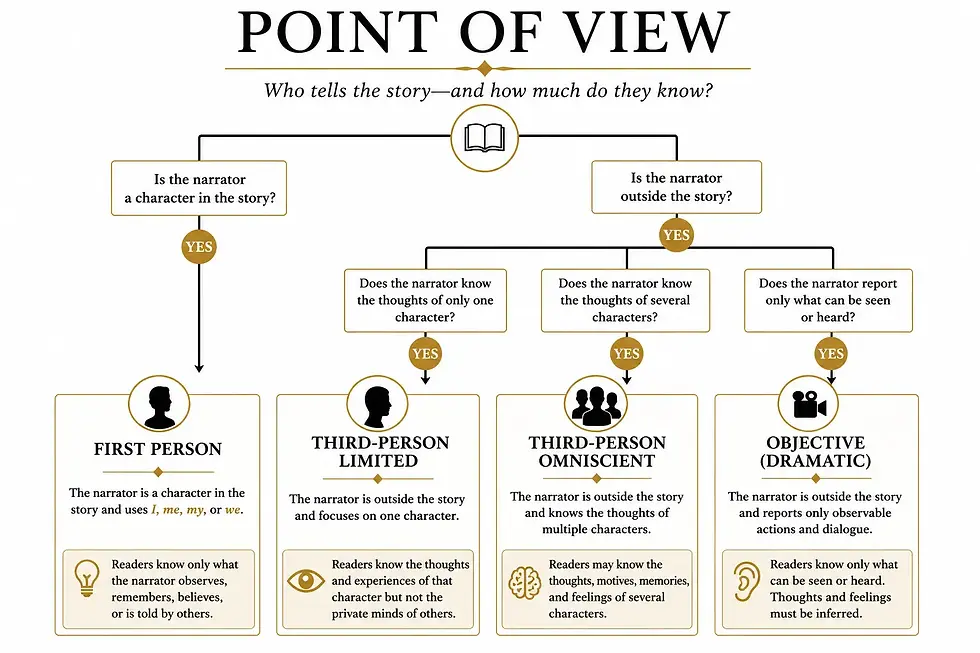
1. First-Person Point of View
In first-person narration, a character tells the story using words such as I, me, my, and we. Readers experience events through that character’s observations, memories, and interpretations rather than through an external narrator.
This is the method Lardner chooses in Haircut. Whitey does not observe the town from outside the action. He belongs to it. He knows its people, shares its customs, and remembers its history. His account therefore combines personal experience with personal judgement. Every description of Jim Kendall, Julie Gregg, Doc Stair, and Paul Dickson is filtered through Whitey’s understanding.
First-person narration also establishes natural limits. Whitey can describe only what he has witnessed or what others have told him. He cannot report Julie Gregg’s private thoughts, explain Jim Kendall’s intentions with certainty, or describe Doc Stair’s inner reactions unless those feelings become visible through words or actions. Readers must therefore distinguish between what Whitey knows, what he believes, and what they themselves may infer from the events he recounts.
2. Third-Person Limited Point of View
In third-person limited narration, the story refers to the central character as he, she, or they while remaining closely restricted to that character’s thoughts and experiences. The central character is still part of the story; only the grammatical perspective has changed.
Compare the following examples.
First person
When I arrived in town, I thought Jim Kendall was simply a cheerful prankster.
Third-person limited
When Doc Stair arrived in town, he thought Jim Kendall was simply a cheerful prankster. As the weeks passed, he began to question that first impression.
If Haircut were written from Doc Stair’s perspective, readers would accompany him throughout the story. We would observe Jim through Doc’s experience, watch his opinion change over time, and understand only those events that Doc himself could witness or reasonably infer. Whitey’s thoughts would remain inaccessible unless they became evident through conversation or behaviour.
Many of the same incidents could still appear, but the narrative would organize them differently. Instead of looking back through Whitey’s memories, readers would experience events as Doc Stair encountered them. The change would alter both the story’s emphasis and the reader’s relationship with its central characters.
3. Third-Person Omniscient Point of View
An omniscient narrator is not limited to the knowledge of any single character. The narration may move freely between different minds, revealing thoughts, motives, memories, and emotions wherever they become relevant.
Applied to Haircut, this method would allow the reader to observe Jim Kendall planning his practical jokes, Julie Gregg’s hopes for her future, Doc Stair’s response to Jim’s deception, and Paul Dickson’s understanding of the final hunting trip. Information unavailable to Whitey could be presented directly rather than inferred from conversation.
Such a version would provide a broader view of the town and its inhabitants. At the same time, it would remove much of the uncertainty created by Whitey’s narration. Readers would no longer depend upon a single storyteller whose understanding differs at times from their own.
4. Objective Point of View
In objective narration, the narrator reports only observable events. Characters speak, act, and respond to one another, but their thoughts and feelings remain undisclosed. Readers must interpret motives from external evidence alone.
If Haircut adopted this method, Whitey’s explanations and opinions would disappear. The narration would present Jim’s actions without describing him as “a good fella at heart” or “certainly a card.” Those judgements belong to Whitey rather than to the events themselves.
The result would be a more detached narrative. Readers would still witness Jim’s behaviour, but they would no longer experience the tension created by Whitey’s continuing admiration. In Haircut, that tension is an important part of the story’s design because it encourages readers to evaluate both the characters and the narrator who introduces them.
Why Lardner Chose First Person
Each form of narration gives readers access to the story in a different way. First-person narration offers intimacy but limits knowledge. Third-person limited follows a single consciousness while maintaining narrative distance. Omniscient narration broadens the reader’s perspective, and objective narration restricts the narrative to observable facts.
Lardner’s choice of first-person narration is therefore more than a grammatical decision. It determines how the reader comes to understand Jim Kendall, Whitey, and the community they inhabit. The story depends not only on the events that occur but also on the voice through which those events are remembered. That relationship between narrator and reader becomes the foundation of Haircut’s point of view.
First Person
Narrator
A character within the story narrates the events.
Scope of Knowledge
Only what the narrator observes, remembers, believes, or learns from others. The narrator may be reliable or unreliable.
Typical Pronouns
I, me, my, we
Examples
Jane Eyre • The Catcher in the Rye • The Great Gatsby
Third-Person Limited
Narrator
An external narrator presents the story through one character.
Scope of Knowledge
The thoughts and experiences of one character, but not the private minds of others.
Typical Pronouns
he, she, they
Examples
Harry Potter and the Philosopher’s Stone • The Old Man and the Sea • The Giver
Third-Person Omniscient
Narrator
An external narrator knows the thoughts and experiences of multiple characters.
Scope of Knowledge
Readers may know the thoughts, motives, memories, and feelings of several characters.
Typical Pronouns
he, she, they
Examples
War and Peace • Middlemarch • Pride and Prejudice
Objective (Dramatic)
Narrator
An external narrator reports only observable actions and dialogue.
Scope of Knowledge
Readers know only what can be observed through actions and dialogue. Thoughts and feelings must be inferred.
Typical Pronouns
he, she, they
Examples
Hills Like White Elephants • The Killers • A Clean, Well-Lighted Place
Reliable and Unreliable Narrators
Not every narrator fully understands the story he tells. A narrator may describe events accurately while interpreting them in ways that readers gradually come to question. For this reason, discussions of point of view often distinguish between reliable and unreliable narrators.
A reliable narrator presents the fictional world in a manner that readers generally accept as trustworthy. His observations, judgements, and explanations are consistent with the evidence provided by the story.
An unreliable narrator, by contrast, presents a more complicated perspective. He may misunderstand events, overlook important details, or interpret people and situations imperfectly. Such a narrator is not necessarily dishonest. He may report events truthfully while drawing conclusions that readers eventually recognize as mistaken.
Whitey is an unreliable narrator. Throughout Haircut, he recounts events as he remembers them, and there is little reason to believe that he deliberately invents incidents or distorts conversations. His reliability is limited not by dishonesty but by interpretation. He sees Jim Kendall differently from the way readers gradually learn to see him.
This distinction becomes increasingly important as the story unfolds. Whitey continues to describe Jim as “a good fella at heart” and “certainly a card,” even after recounting episodes involving Julie Gregg, Doc Stair, and Paul Dickson. Readers hear the same stories that Whitey tells, yet they arrive at different conclusions. The narrative therefore operates on two levels: Whitey offers one interpretation of Jim’s character, while the evidence itself encourages another. Much of the story’s irony arises from the widening distance between these two perspectives.
Narrative Voice
Point of view identifies who tells a story. Narrative voice refers to how that story is told.
A narrator’s voice is revealed through vocabulary, sentence structure, humour, habits of expression, and the way events and characters are described.
These features give the narration its distinctive personality and shape the reader’s first impression of the storyteller.
Whitey’s voice in Haircut is consistently conversational. His stories wander naturally from one topic to another, his language resembles everyday small-town speech, and he offers opinions with complete confidence and little self-consciousness. As a result, readers are inclined to trust him long before they begin to question his interpretation of events.
Narrative voice therefore does more than create atmosphere. It shapes the reader’s relationship with the narrator. Whitey’s friendly, familiar manner establishes credibility, even as the story gradually reveals that his understanding of Jim Kendall differs from the conclusions readers draw for themselves.
Why Lardner Chose Whitey
The choice of narrator determines more than the way a story is told. It also determines what readers are able to see. Every narrator reveals certain aspects of the fictional world while leaving others in the background.
Whitey’s narration introduces not only Jim Kendall but also the values of the small community in which he lives. His easy admiration for Jim, his willingness to excuse behaviour that others may condemn, and his unquestioning acceptance of local attitudes reveal assumptions shared by the town itself. Readers therefore learn about the community through Whitey’s understanding of it.
A different narrator would produce a different story. If Jim Kendall told the events, readers would see the world from the practical joker’s perspective. If Julie Gregg narrated the story, the emotional consequences of Jim’s behaviour would move to the foreground. If Doc Stair became the narrator, the story would follow the judgement of a man whose view of Jim differs sharply from Whitey’s. The major events might remain much the same, but their meaning would change because the perspective had changed.
Lardner chooses none of these narrators. Instead, he entrusts the story to Whitey. Readers therefore do more than observe the events of Haircut; they interpret those events alongside the man who remembers them. Whitey’s narration is not merely the medium through which the story is told. It is one of the story’s central artistic choices and an essential part of its meaning.
✧ ✦ ✧ ✦ ✧ ✦ ✧


Comments